Irish Time

Wednesday, May 15, 2013

DIRTY LETTERS IRELAND


By Julieann Veronica Ulin

O'Roric, prince of Meath, have gone on an expedition into a distant quarter, left his wife [Dervorgilla] . . . in a certain island in Meath during his absence; and she, who had long entertained a passion for Dermitius, took advantage of the absence of her husband, and allowed herself to be ravished, not against her will. As the nature of women is fickle and given to change, she thus became the prey of her spoiler by her own contrivance. For as Mark Anthony and Troy are witnesses, almost all the greatest evils in the world have arisen from women.
—Giraldus Cambrensis, The History of the Conquest of Ireland (1189)
The story has gone abroad, through one Giraldus Cambrensis, that my wickedness, like that of fair Helen of Greece, wrecked the nation, and I have been made to bear the burden of the downfall of my country and the dishonor of my good name.
—Anna C. Scanlan, Dervorgilla; or, The Downfall of Ireland (1895)
Drunk and sitting on a barstool, ranting to all who will listen, James Joyce's citizen in the Cyclops episode of Ulysses (1922) offers the following explanation for Ireland's colonial condition and the subsequent centuries of violence, oppression, a lost language, emigration, and famine: "The adulteress and her paramour brought the Saxon robbers here. . . . A dishonoured wife, says the citizen, that's what's the cause of all our misfortunes" (Joyce 1986, 266). The dishonored wife and the adulteress referenced here is Dervorgilla, a twelfth-century queen whose personal narrative of seduction and abduction had, during her own lifetime, become fused with Ireland's national narrative of ruin. Writers as diverse as U.S. president John Quincy Adams and Nobel laureate W. B. Yeats offered later versions of Dervorgilla's role in Ireland's colonial subjugation. Regularly vilified in historical and literary narratives, Dervorgilla became known as "Erin's Helen," Ireland's own Helen of Troy. The continuous circulation and retelling of her story ensured that centuries of colonial oppression became traceable to this "dishonoured wife."
The citizen's explanation refers to the seduction or abduction (depending on the version) of the married Dervorgilla by Diarmuid Mac Murrough, king of the Irish province of Leinster. In the first book of his twelfth-century The History of the Conquest of Ireland(repeatedly quoted by the writers who return to the narrative of Dervorgilla centuries later) Giraldus Cambrensis writes:
[Diarmuid's] youth and inexperience in government led him to become the oppressor of the nobility, and to impose a cruel and intolerable tyranny on the chiefs of the land. This brought him into trouble, and it was not the only one; for O'Roric, prince of Meath, having gone on an expedition into a distant quarter, left his wife [Dervorgilla] . . . in a certain island in Meath during his absence; and she, who had long entertained a passion for [Diarmuid], took advantage of the absence of her husband, and allowed herself to be ravished, not against her will. As the nature of women is fickle and given to change, she thus became the prey of her spoiler by her own contrivance. For as Mark Anthony and Troy are witnesses, almost all the greatest evils in the world have arisen from women.
In retaliation for this great shame, O'Rourke gathered forces against Diarmuid, and within a year, in 1153, Dervorgilla was recovered. As might be expected, tension and conflict continued between the two men. In 1167, fourteen years after the abduction, Diarmuid's many enemies and former allies turned against him, and he was driven out of his capital city, Ferns. Cambrensis writes of the exiled Diarmuid's decision to seek aid from King Henry II, the decision that, combined with his abduction of Dervorgilla, would be read as the origin story for the English involvement in Ireland. In 1167, Diarmuid returned to Ireland with a small force..

James Joyce's dirty letters


To NORA BARNACLE from GALWAY

Dublin   2 December 1909
………………………….
My love for you allows me to pray to the spirit of eternal beauty and tenderness mirrored in your eyes or fling you down under me on that softy belly of yours and fuck you up behind, like a hog riding a sow, glorying in the very stink and sweat that rises from your arse, glorying in the open shape of your upturned dress and white girlish drawers and in the confusion of your flushed cheeks and tangled hair. It allows me to burst into tears of pity and love at some slight word, to tremble with love for you at the sounding of some chord or cadence of music or to lie heads and tails with you feeling your fingers fondling and tickling my ballocks or stuck up in me behind and your hot lips sucking off my cock while my head is wedged in between your fat thighs, my hands clutching the round cushions of your bum and my tongue licking ravenously up your rank red cunt. I have taught you almost to swoon at the hearing of my voice singing or murmuring to your soul the passion and sorrow and mystery of life and at the same time have taught you to make filthy signs to me with your lips and tongue, to provoke me by obscene touches and noises, and even to do in my presence the most shameful and filthy act of the body. You remember the day you pulled up your clothes and let me lie under you looking up at you while you did it? Then you were ashamed even to meet my eyes.

You are mine, darling, mine! I love you. All I have written above is only a moment or two of brutal madness. The last drop of seed has hardly been squirted up your cunt before it is over and my true love for you, the love of my verses, the love of my eyes for your strange luring eyes, comes blowing over my soul like a wind of spices. My prick is still hot and stiff and quivering from the last brutal drive it has given you when a faint hymn is heard rising in tender pitiful worship of you from the dim cloisters of my heart.

Nora, my faithful darling, my seet-eyed blackguard schoolgirl, be my whore, my mistress, as much as you like (my little frigging mistress! My little fucking whore!) you are always my beautiful wild flower of the hedges, my dark-blue rain-drenched flower.

JIM


To NORA

 Dublin  3 December 1909
……………………………….
……., you seem to turn me into a beast. It was you yourself, you naughty shameless girl who first led the way. It was not I who first touched you long ago down at Ringsend. It was you who slid your hand down down inside my trousers and pulled my shirt softly aside and touched my prick with your long tickling fingers and gradually took it all, fat and stiff as it was, into your hand and frigged me slowly until I came off through your fingers, all the time bending over me and gazing at me out of your quiet saintlike eyes. It was your lips too which first uttered an obscene word. I remember well that night in bed in Pola.

Tired of lying under a man one night you tore off your chemise violently and got on top of me to ride me naked. You stuck my prick into your cunt and began to ride me up and down. Perhaps the horn I had was not big enough for you for I remember that you bent down to me face and murmured tenderly "Fuck up, love! Fuck up, love!"

Nora dear, I am dying all day to ask you one or two questions. Let me, dear, for I have told you everything I ever did and so I can ask you in turn. When that person (Vincent Cosgrave) whose heart I long to stop with the click of a revolver put his hand or hands under your skirts did he only tickle you outside or did he put his finger or fingers up into you? If he did, did they go up far enough to touch that little cock at the end of your cunt? Did he touch you behind? Was he a long time tickling you and did you come? Did he ask you to touch him and did you do so? If you did not touch him did he come against you and did you feel it?

Another question, Nora. I know that I was the first man that blocked you but did any man ever frig you? Did that boy (Michael Bodkin) you were fond of ever do it? Tell me now, Nora, truth for truth, honesty for honesty. When you were with him in the dark at night did your fingers never, never unbutton his trousers and slip inside like mice? Did you ever frig him, dear, tell me truly or anyone else? Did you never, never, never feel a man's or a boy's prick in your fingers until you unbuttoned me?  If you are not offended do not be afraid to tell me the truth. Darling, darling, tonight I have such a wild lust for your body that if you were here beside me and even if you told me with your lips that half the redheaded louts in the county Galway had had a fuck at you before me I would still rush at you with desire.

…………………………………………………….


To NORA
Dublin 6 December 1909
………………………………..
I would like you to wear drawers with three or four frills one over the other at the knees and up the thighs and great crimson bows in them, I mean not schoolgirls' drawers with a thin shabby lace border, thigh round the legs and so thin that the flesh shows with a full loose bottom and wide legs, all frills and lace and ribbons, and heavy with perfume so that whenever you show them, whether in pulling up your clothes hastily to do something or cuddling yourself up prettily to be blocked, I can see only a swelling mass of white stuff and frills and so that when I bend down over you to open them and give you a burning lustful kiss on your naughty bare bum I can smell the perfume of your drawers as well as the warm odour of your cunt and the heavy smell of your behind.

Have I shocked you by the dirty things I wrote to you? You think perhaps that my love is a filthy thing. It is, darling, at some moments. I dream of you in filthy poses sometimes. I imagine things so very dirty that I will not write them until I see how you write yourself. The smallest things give me a great cockstand - a whorish movement of your mouth, a little brown stain on the seat of your white drawers, a sudden dirty word spluttered out by your wet lips, a sudden immodest noise made by you behind and then a bad smell slowly curling up out of your backside. At such moments I feel mad to do it in some filthy way, to feel your hot lecherous lips sucking away at me, to fuck between your two rosy-tipped bubbies, to come on your face and squirt it over your hot cheeks and eyes, to stick it between the cheeks of your rump and bugger you.

Basta per stasera!

I hope you got my telegram and understood it.

Goodbye, my darling whom I am trying to degrade and deprave. How on God's earth can you possibly love a thing like me?

O, I am anxious to get your reply, darling!

 JIM


To NORA
Dublin  8 December 1909
My sweet little whorish Nora I did as you told me, you dirty little girl, and pulled myself off twice when I read your letter. I am delighted to see that you do like being fucked arseways. Yes, now I can remember that night when I fucked you for so long backwards. It was the dirtiest fucking I ever gave you, darling. My prick was stuck in you for hours, fucking in and out under your upturned rump. I felt your fat sweaty buttocks under my belly and saw your flushed face and mad eyes. At every fuck I gave you your shameless tongue came bursting out through your lips and if a gave you a bigger stronger fuck than usual, fat dirty farts came spluttering out of your backside. You had an arse full of farts that night, darling, and I fucked them out of you, big fat fellows, long windy ones, quick little merry cracks and a lot of tiny little naughty farties ending in a long gush from your hole. It is wonderful to fuck a farting woman when every fuck drives one out of her. I think I would know Nora's fart anywhere. I think I could pick hers out in a roomful of farting women. It is a rather girlish noise not like the wet windy fart which I imagine fat wives have. It is sudden and dry and dirty like what a bold girl would let off in fun in a school dormitory at night. I hope Nora will let off no end of her farts in my face so that I may know their smell also.

You say when I go back you will suck me off and you want me to lick your cunt, you little depraved blackguard. I hope you will surprise me some time when I am asleep dressed, steal over to me with a whore's glow in your slumberous eyes, gently undo button after button in the fly of my trousers and gently take out your lover's fat mickey, lap it up in your moist mouth and suck away at it till it gets fatter and stiffer and comes off in your mouth. Sometimes too I shall surprise you asleep, lift up your skirts and open your drawers gently, then lie down gently by you and begin to lick lazily round your bush. You will begin to stir uneasily then I will lick the lips of my darling's cunt. You will begin to groan and grunt and sigh and fart with lust in your sleep. Then I will lick up faster and faster like a ravenous dog until your cunt is a mass of slime and your body wriggling wildly.

Goodnight, my little farting Nora, my dirty little fuckbird! There is one lovely word, darling, you have underlined to make me pull myself off better. Write me more about that and yourself, sweetly, dirtier, dirtier.

JIM


To NORA
Dublin  9 December 1909
My sweet naughty little fuckbird, Here is another note to buy pretty drawers or stockings or garters. Buy whorish drawers, love, and be sure you sprinkle the legs of them with some nice sent and also discolour them just a little behind.

You seem anxious to know how I received your letter which you say is worse than mine. How is it worse than mine, love? Yes, it is worse in one part or two. I mean the part where you say what you will do with your tongue (I don't mean sucking me off) and in that lovely word you write so big and underline, you little blackguard. It is thrilling to hear that word (and one or two others you have not written) on a girl's lips. But I wish you spoke of yourself and not of me. Write me a long long letter , full of that and other things, about yourself, darling. You know now how to give me a cockstand. Tell me the smallest things about yourself so long as they are obscene and secret and filthy. Write nothing else. Let every sentence be full of dirty immodest words and sounds. They are all lovely to hear and to see on paper even but the dirtiest are the most beautiful.

The two parts of your body  which do dirty things are the loveliest to me. I prefer your arse, darling, to your bubbies because it does such a dirty thing. I love your cunt not so much because it is the part I block but because it does another dirty thing. I could lie frigging all day looking at the divine word you wrote and at the thing you said you would do with your tongue. I wish I could hear your lips spluttering those heavenly exciting filthy words, see your mouth making dirty sounds and noises, feel your body wriggling under me, hear and smell the dirty fat girlish farts going pop pop out of your pretty bare girlish bum and fuck fuck fuck fuck my naughty little hot fuckbird's cunt for ever.

I am happy now, because my little whore tells me she wants me to roger her arseways and wants me to fuck her mouth and wants to unbutton me and pull out my mickey and suck it off like a teat. More and dirtier than this she wants to do, my little naked fucker, my naughty wriggling little frigger, my sweet dirty little farter.

Goodnight, my little cuntie I am going to lie down and pull at myself until I come. Write more and dirtier, darling. Tickle your little cockey while you write to make you say worse and worse. Write the dirty words big and underline them and kiss them and hold them for a moment to your sweet hot cunt, darling, and also pull up your dress a moment and hold them under your dear little farting bum. Do more if you wish and send the letter then to me, my darling brown-arsed fuckbird.

JIM


To NORA
Dublin (?) 13 December 1909
....................................
I would be delighted to feel my flesh tingling under your hand . Do you know what I mean, Nora dear? I wish you would smack me or flog me even. Not in play, dear, in earnest and on my naked flesh. I wish you were strong, strong, dear, and had a big full proud bosom and big fat thighs.  I would love to be whipped by you, Nora love! I would love to have done something to displease you, something trivial even, perhaps one of my rather dirty habits that make you laugh: and then to hear you call me into your room and then to find you sitting in an armchair with your fat thighs far apart and your face deep red with anger and a cane in your hand. To see you point to what I had done and then with a movement of rage pull me towards you and throw me face downwards across your lap. Then to feel your hands tearing down my trousers and inside clothes and turning up my shirt, to be struggling in your strong arms and in your lap, to feel you bending down (like an angry nurse whipping a child's bottom) until your big full bubbies almost touched me and to feel you flog, flog, flog me viciously on my naked quivering flesh!!

………………………………

To NORA
Dublin  15 December 1909
………………………………………….
No letter! Now I am sure my girlie is offended at my filthy words. Are you offended, dear, as what I said about your drawers? That is all nonsense, darling. I know they are spotless as your hearth. I know I could lick them all over, frills, legs and bottom. Only I love in my dirty way to think that in a certain part they are soiled. It is all nonsense, too, dear, about buggering you. It is only the dirty sound of the word I like, the idea if a shy beautiful young girl like Nora pulling up her clothes behind and revealing her sweet white girlish drawers in order to excite the dirty fellow she is so fond of; and then letting him stick his dirty red lumpy pole in through the split of her drawers and up up up in the darling little hole between her plump fresh buttocks.

Darling, I came off just now in my trousers so that I am utterly played out. I cannot go to the G.P.O. though I have three letters to post.

To bed - to bed!
Goodnight, Nora mia!

JIM


To NORA
Dublin   16 December 1909
My sweet darling girl At last you write to me! You must have given that naughty little cunt of yours a most ferocious frigging to write me such a disjointed letter. As for me, darling, I am so played out that you would have to lick me for a good hour before I could get a horn stiff enough even to put into you, to say nothing of blocking you. I have done so much and so often that I am afraid to look to see how that thing I had is after all I have done to myself. Darling, please don't fuck me too much when I go back. Fuck all you can out of me for the first night or so but make me get myself cured. The fucking must all be done by you, darling as I am so small and soft now that no girl in Europe except yourself would waste her time trying the job. Fuck me, darling, in as many new ways as your lust will suggest. Fuck me dressed in your full outdoor costume with your hat and veil on, your face flushed with the cold and wind and rain and your boots muddy, either straddling across my legs  when I am sitting in a chair and riding me up and down with the frills of your drawers showing and my cock sticking up stiff in your cunt or riding me over the back of the sofa. Fuck me naked with your hat and stockings on only flat on the floor with a crimson flower in your hole behind, riding me like a man with your thighs between mine and your rump very fat. Fuck me in your dressing gown (I hope you have that nice one) with nothing on under it, opening it suddenly and showing me your belly and thighs and back an pulling me on top of you on the kitchen table. Fuck me into you arseways, lying on your face on the bed, with your hair flying loose naked but with a lovely scented pair of pink drawers opened shamelessly behind and half sleeping down over your peeping bum. Fuck me on the stairs in the dark, like a nursery-maid fucking her soldier, unbuttoning his trousers gently and slipping her hand in his fly and fiddling with his shirt and feeling it getting wet and then pulling it gently up and fiddling with his two bursting balls and at last pulling out boldly the mickey  she loves to handle and frigging it for him softly, murmuring into his ear dirty words and dirty stories that other girls told her and dirty things she said, and all the time pissing her drawers with pleasure and letting off soft warm quiet little farts behind until her own girlish cockey is as stiff as his and suddenly sticking him up in her and riding him.

Basta! Basta per Dio!

I have come now and the foolery is over.  Now for your questions!

…………………………………………..
Get ready. Put some warm-brown-linoleum on the kitchen and hang a pair of red common curtains on the windows at night. Get some kind of a cheap common comfortable armchair for your lazy lover. Do this above all, darling, as I shall not quit that kitchen for a whole week after I arrive, reading, lolling, smoking, and watching you get ready the meals and talking, talking, talking, talking to you.  O how supremely happy I shall be! God in heaven, I shall be happy there! I figlioli, il fuoco, una buona mangiata, un caffè nero, un Brasil (cigar), il Piccolo della Sera, e Nora, Nora mia, Norina, Noretta, Noruccia ecc ecc...

Eva and Eileen must sleep together. Get some place for Georgie. I wish Nora and I had two beds for night-work. I am keeping and shall keep my promise, love. Time fly on quickly! I want to go back to my love, my life, my star, my little strange-eyed Ireland!

A hundred thousand kisses, darling!

JIM


To NORA
Dublin    20 December 1909
My sweet naughty girl   I got your hot letter tonight and have been trying to picture you frigging your cunt in the closet. How do you do it? Do you stand against the wall with your hand tickling up under your clothes or do you squat down on the hole with your skirts up and your hand hard at work in through the slit of your drawers? Does it give you the horn now to shit? I wonder how you can do it. Do you come in the act of shitting or do you frig yourself off first and then shit? It must be a fearfully lecherous thing to see a girl with her clothes up frigging furiously at her cunt, to see her pretty white drawers pulled open behind and her bum sticking out and a fat brown thing stuck half-way out of her hole. You say you will shit your drawers, dear, and let me fuck you then. I would like to hear you shit them, dear, first and then fuck you. Some night when we are somewhere in the dark and talking dirty and you feel your shite ready to fall put your arms round my neck in shame and shit it down softly. The sound will madden me and when I pull up your dress

No use continuing! You can guess why!


Tuesday, May 14, 2013

SS UK TAILS WAG US WASP DOGS OF WAR


Frontline: Top Secret America by Info4uAndMe
THE POLITICAL TEST LABORATORY OF BRITISH OCCUPIED IRELAND


The Guineapigs

The Guineapigs were fourteen Irish political prisoners on whom the British Army experimented with sensory deprivation torture in 1971. It still continues 40 years later, on Marian Price who is experimented on, in a British military Hospital in Belfast today after her sister Dolours died as a result of drug experiments carried out on her while being forced fed 40 years ago. These 'techniques' were outlawed, following Britain's conviction at the International Court of Human Rights at Strasbourg, but were exported by SS UK and used by their WASPs in the USA. 

In Ireland in 1971, there was a deliberate and careful use of modern torture techniques, not just to get information but to perfect the SS UK system of Sensory Deprivation for use against civilians. An ex-internee John McGuffin spent two years researching a book he wrote, following his release from where he had been held without charge or trial. The book called 'The Guineapigs"  was dedicated to the blanket men in Long Kesh concentration camp and the women political prisoners in Armagh jail. 'Na reabhloidi Abu.'


The CIA operates under orders from British

intelligence and was created by British intelligence 

in 1947. The CIA today is still loyal to the 

international bankers based in the city of London

and the global elite aristocratic families like the 

Rothschild’s and the Windsor’s. Since it was first 

started, MI6 has always brought drugs into Britain. 

They do not bring ‘some’ of the drugs into Britain but

 I would estimate MI6 bring in around ninety

percent of the drugs in. They do this by pulling the

 strings of many organised crime and terrorist 

groups and these groups like the IRA are full of MI6

agents...  James Casbolt


Webhttp://www.jamescasbolt.com


[2006] Underground Bases, Missing Children and Extra-Terrestrials  By James Casbolt,

[2006] Global drug trade is controlled and run by the intelligence agencies by James Casbolt

Clones, bio-plasmics and world leaders by James Casbolt

Friends and Star Kids
http://www.movie3mai.net/dnKLolaw3Pe4.html

[2006] Whistleblower dies in suspicious circumstances on stage at UFO conference

BookAgent Buried Alive, The Autobiography of Commander James Casbolt (2008)


It may be a revelation to many people that the global drug trade is controlled and run by the intelligence agencies. In this global drug trade British intelligence reigns supreme. As intelligence insiders know MI5 and MI6 control many of the other intelligence agencies in the world (CIA, MOSSAD etc) in a vast web of intrigue and  corruption that has its global power base in the city of London, the square mile.  My name is James Casbolt, and I worked for MI6 in ‘black ops’ cocaine trafficking with the IRA and MOSSAD in London and Brighton between 1995 and 1999. My father Peter Casbolt was also MI6 and worked with the CIA and mafia in Rome, trafficking cocaine into Britain. My experience was that the distinctions of all these groups became blurred until in the end we were all one international group working together for the same goals. We were puppets who had our strings pulled by global puppet masters based in the city of London. Most levels of the intelligence agencies are not loyal to the people of the country they are based in and see themselves as ‘super national’.
It had been proved beyond a shadow of a doubt that the CIA has been bringing in most of the drugs into America for the last fifty years (see ex LAPD officer Michael Rupert’s ‘From the wilderness’ website for proof). The CIA operates under orders from British intelligence and was created by British intelligence in 1947. The CIA today is still loyal to the international bankers based in the city of London and the global elite aristocratic families like the Rothschild’s and the Windsor’s. Since it was first started, MI6 has always brought drugs into Britain. They do not bring ‘some’ of the drugs into Britain but I would estimate MI6 bring in around ninety percent of the drugs in. They do this by pulling the strings of many organised crime and terrorist groups and these groups like the IRA are full of MI6 agents.
MI6 bring in heroin from the middle east, cocaine from south America and cannabis from morocco as well as other places. British intelligence also designed and created the drug LSD in the 1950′s through places like the Tavistock Institute in London. By the 1960′s MI5, MI6 and the CIA were using LSD as a weapon against the angry protestors of the sixties and turned them into ‘flower children’ who were too tripped out to organise a revolution.
Dr Timothy Leary the LSD guru of the sixties was a CIA puppet. Funds and drugs for Leary’s research came from the CIA and Leary says that Cord Meyer, the CIA agent in charge of funding the sixties LSD counter culture has ”helped me to understand my political cultural role more clearly”. In 1998, I was sent 3000 LSD doses on blotting paper by MI5 with pictures of the European union flag on them. The MI5 man who sent them told my father this was a government ‘signature’ and this LSD was called ‘Europa’.
This global drugs trade controlled by British intelligence is worth at least 500 billion a year. This is more than the global oil trade and the economy in Britain and America is totally dependent on this drug money. Mafia crime boss John Gotti exposed the situation when asked in court if he was involved in drug trafficking. He replied “No we can’t compete with the government”. I believe this was only a half truth because the mafia and the CIA are the same group at the upper levels. In Britain, the MI6 drug money is laundered through the Bank of England, Barclays Bank and other household name companies. The drug money is passed from account to account until its origins are lost in a huge web of transactions. The drug money comes out ‘cleaner’ but not totally clean. Diamonds are then bought with this money from the corrupt diamond business families like the Oppenheimers. These diamonds are then sold and the drug money is clean. MI6 and the CIA are also responsible for the crack cocaine epidemic in Britain and America.  In 1978, MI6 and the CIA were in south America researching the effects of the natives smoking ‘basuco’ cocaine paste. This has the same effect as crack cocaine. They saw that the strength and addiction potential was far greater than ordinary cocaine and created crack cocaine from the basuco formula. MI6 and the CIA then flooded Britain and America with crack [see Gary Webb--ed]. Two years later, in 1980, Britain and America were starting to see the first signs of the crack cocaine epidemic on the streets. On august 23, 1987, in a rural community south of Little Rock in America, two teenage boys named Kevin Ives and Don Henry were murdered and dismembered after witnessing a CIA cocaine drop that was part of a CIA drug trafficking operation based at a small airport in Mena, Arkansas. Bill Clinton was the governor of Arkansas at the time. Bill Clinton was involved with the CIA at this time and $100 million worth of cocaine was coming through the Mena, Arkansas airport each month. For proofsee the books ‘Compromise’ and ‘Dope Inc’.
On my father’s international MI6 drug runs, whatever fell off the back of the lorry so to speak he would keep and we would sell it in Britain. As long as my father was meeting the speedboats from Morocco in the Costa del Sol and then moving the lorry loads of cannabis through their MI6, IRA lorry business into Britain every month, British intelligence were happy. As long as my father was moving shipments of cocaine out of Rome every month, MI5 and MI6 were happy. If my father kept a bit to sell himself no one cared because there was enough drugs and money to go round in this £500 billion a year global drugs trade. The ones who were really paying were the people addicted. Who were paying with suffering. But karma always catches up and both myself and my father became addicted to heroin in later years and my father died addicted, and poor in prison under very strange circumstances. Today, I am clean and drug-free and wish to help stop the untold suffering this global drugs trade causes. The intelligence agencies have always used addictive drugs as a weapon against the masses to bring in their long term plan for a one world government, a one world police force designed to be NATO and a micro chipped population known as the New World Order. As the population is in a drug or alcohol-induced trance watching ‘Coronation Street’, the new world order is being crept in behind them.
To properly expose this global intelligence run drugs trade we need to expose the key players in this area:
1- Tibor Rosenbaum, a MOSSAD agent and head of the Geneva based Banque du Credit international. This bank was the forerunner to the notorious Bank of Credit and Commerce international (BCCI) which is a major intelligence drug money laundering bank. ‘Life’ magazine exposed Rosenbaum’s bank as a money launderer for the Meyer Lanksky American organised crime family and Tibor Rosenbaum funded and supported ‘Permindex’ the MI6 assassination unit which
was at the heart of the John F. Kennedy assassination.
2- Robert Vesco, sponsored by the Swiss branch of the Rothchilds and part of the American connection to the Medellin drug cartel in Columbia.
3- Sir Francis de Guingand, former head of British intelligence, now living in south Africa (and every head of MI5 and MI6 has been involved in the drug world before and after him).
4- Henry Keswick, chairman of Jardine Matheson which is one of the biggest drug trafficking operations in the world. His brother John Keswick is chairman of the bank of England.
5- Sir Martin Wakefield Jacomb, Bank of England director from 1987 to 1995, Barclays Bank Deputy Chairman in 1985, Telegraph newspapers director in 1986 ( This is the reason why this can of worms doesn’t get out in the mainstream media. The people who are perpetrating these crimes control most of the mainstream media. In America former director of the CIA William Casey was, before his death in 1987, head of the council of the media network ABC. Many insiders refer to ABC as ‘The CIA network.)
6- George Bush, Snr, former President and former head of the CIA and America’s leading drug baron who has fronted more wars on drugs than any other president. Which in reality is just a method to eliminate competition. A whole book could be written on George Bush’s involvement in the global drug trade but it is well-covered in the book ‘Dark Alliance’ by investigative journalist Gary Webb.
Gary Webb was found dead with two gunshot wounds to the back of his head with a revolver. The case was declared a ‘suicide’. You figure that out. Gary Webb as well as myself and other investigators, found that much of this ‘black ops’ drug money is being used to fund projects classified ab ove top secret. These projects include the building and maintaining of deep level underground bases in Dulce in New Mexico, Pine gap in Australia, Snowy mountains in Australia, The Nyala range in Africa, west of Kindu in Africa, next to the Libyan border in Egypt, Mount Blanc in Switzerland, Narvik in Scandinavia, Gottland island in Sweden and many other places around the world (more about these underground bases in my next issue). The information on this global drugs trade run by the intelligence agencies desperately needs to get out on a large scale. Any information, comments or feedback to help me with my work would be greatly welcomed.

BRITISH GOVERNMENT DISMANTLING IRISH PEACE PROCESS


Gerry Adams has informed the Dáil or Irish parliament that decisions made by the British Tory government, have seriously undermined the Belfast Agreement and the work of political institutions of the Irish Peace Process.

He also accused the current and past Irish governments in the Republic of taking their eye off the North. There are outstanding issues, such as a bill of rights an Irish language act, also to be dealt with.

“The Government is a co-equal guarantor with the British government of this agreement.This is not the British government’s agreement.’’

Mr Adams said the British government had reneged on an €18 billion commitment agreed to develop an economic peace dividend. He called on Taoiseach Enda Kenny to join with him in calling on the British government to honour its commitments.Besides the examples of several breaches by the British of the Peace Process mentioned above, other Tory Government broken promises are as follows.

In the instance of the murder by the British Government death squads of a human rights lawyer, the party on behalf of Pat Finucane visiting Downing Street recently, included Pat’s widow Geraldine, children, Michael, Katherine and John; Pat’s brothers Martin and Seamus, former business partner, Peter Madden and campaigner, Jane Winter, arrived on a Tuesday afternoon.

Cameron entered the room, accompanied by VIceroyal for British Occupied Ireland, Owen Paterson and Cameron’s private secretary.Initially, things looked promising with Cameron, according to John Finucane:

“He came into the room and apologised to us on behalf of the British government for the collusion in my father’s murder. He also apologised for all the delays and broken promises which successive British governments have made to us for the last 10 years.

“We fully expected at that point that he was going to announce to us that he was going to allow an inquiry into my father’s murder. We had been led to believe for more than a year that this was what was going to happen. Instead he proceeded to inform us that he had asked a barrister to review papers in the case and report back to the Secretary of State. It was a total insult.”

The meeting was then immediately ended by Geraldine Finucane, when it was clear the British Prime Minister was ruling out any inquiry.John Finucane, said, “I think Mummy had had enough, she just said she didn’t want to hear anymore.She said she wanted the meeting to end.” Outside 10 Downing Street, Mrs Finucane said her rage was such that she could barely speak.There has also been an angry response from nationalist and human rights quarters.

Cameron’s handling of this case has surprised those who praised him for his handling of the Bloody Sunday Inquiry when he apologised to the 14 innocent victims shot by the British Army on the streets of Derry.

His treatment of the Finucanes, in contrast, reneges on the international agreement his government made with its Irish counterparts at Weston Park in 2001 as part of the Irish Peaxe Process to hold an inquiry into the Finucane murder.So what have the British got to hide?

British/Irish Rights Watch spokesperson Jane Winter, who was at the Downing Street meeting, said she is convinced that there are individuals in the highest echleons of the British establishment who do not want their role in the events surrounding Pat Finucane’s murder to become public.

“I have come to the conclusion that there is something about Patrick Finucane’s death that successive governments have tried to hide and still want to hide,” she said.

“There’s something so utterly damning that they don’t want the public to know.”

Referring to the detailed discussions which had taken place between Downing Street officials and the Finucane’s lawyers, Ms Winter said:

“There have been extensive talks for over a year between the two legal teams.

“All the talk was about what sort of public inquiry could be agreed.

“It certainly was more than what was offered by David Cameron.”

“The prime minister expressed his profound sympathy for the family and said it was clear from (the) Stevens and Cory (inquiries) that state collusion had taken place in Mr Finucane’s murder and he accepted these conclusions.

“On behalf of the government he apologised to the family.

“He confirmed that the government’s priority was to get to the truth in the best and most effective way and the secretary of state will set out the details for this process shortly.”

Sir Jeremy Heywood, the Cabinet Secretary, also questioned whether the Prime Minister believed it was right to “renege” on a previous Government's commitment to hold a public inquiry into a killing he referred to as “a dark moment in the country's history.” 

In an email Sir Jeremy sent to Simon King, the private secretary to the British Prime Minister he asked, “Does the PM seriously think that it's right to renege on a previous Government's clear commitment to hold a full judicial inquiry?

“This was a dark moment in the country's history, far worse than anything that was alleged in Iraq/Afghanistan. I can’t really think of any argument to defend not having a public inquiry. What am I missing?” A reply email stated that Cameron “shares the view this is an awful case, and far worse than any post 9/11 allegation.”

Another item reneged on by the British, is the reintroduction of internment without trial, with the theft of a Royal Pardon by Britain's secret services MI5 and the shredding of the Royal document by the out of control British spooks. Both of these innocent, senior traditional Irish republicans, Marian Price and Martin Corey, have been kidnapped by the British Secret Service Mafia MI5 and imprisoned indefinitely by secret kangaroo courts.

Few British prime ministers have been as tireless in promoting Britain's arms industry as David Cameron. He calls it a key part of the UK's economy and he was heavily sponsored in the last election by the the British industrial war complex. He has promoted wars, arms and sectarianism not just in Afghanistan and the rich Gulf States in huge arms deals but has also promoted sectarianism in Libya and Syria.  

The British Tory Government policies, aside from breaking and ignoring the Irish Peace Process, is hell bent on promoting sectarianism in Ireland, as an excuse and  justification for another profitable British war, on ordinary Irish people. The British Tories are dismantling the Irish Peace Process, as part of their permanent war business worldwide.

MEMORY OF JIM McALISTER


In memory of Jim McAllister


jimmcallister.jpg


The following oration was delivered by former councillor Pat McNamee at the graveside of former colleague Jim McAllister who died of cancer last month.
Ta failte romhaibh uilig anseo inniu chuig cuireadh Jim McAllister. Silim ghfuil se oiriunach cur tus leis mo chuid cainte as Gaeilge. Ba ghaeilgeoir Jim comh maith le gach rud eile.
Most of you will have known Jim McAllister as an Irish republican and political spokesperson from South Armagh. It is appropriate for me to use a few words of Irish as Jim was a Gaeilgeoir and loved his language and his culture as well as his country.
It is a difficult task for me to speak about such a great man. Jim wasn’t a big man in stature but he was a great man in heart and mind. As well as being a gaeilgeoir and a politician he was a father and a husband, he was a craftsman with many skills. He was self educated in Irish History and politics and he was well read in the folklore and legend of Ulster and Ireland. Indeed Jim might say that it can be hard to distinguish nowadays between the history and the folklore or more recent times. Jim was also a songwriter and a poet. One of the best things of all about Jim was that he could tell a great yarn, he had humour and wit and he was mighty crack to be with. I am proud to speak about Jim today for his family Turlough, Aoibhinn and Brendan.
Turlough was released this morning at 8.00am from Magilligan Prison to be here today. Jim hoped the he was going to live long enough to see Turlough released in less than 18 months time but in recent weeks Jim knew that his time was running out. The family requested that Turlough would be released to see his father before his death. They refused. Some people tell us that we are ‘moving forward’.
I won’t try to cover all of Jim’s life but I want to give you a snapshot of the man that I came to know as a comrade and a friend. I met Jim when I was a teenager when Jim returned home having worked in England. I heard of him first as the author of a famous poem in the Crossmaglen/Cullyhanna area, the ‘Daffodil man from Kiltybane’. I’ll return to that later.
Jim was an Irish republican and he grew to be a republican as he educated himself in Irish history and politics. He believed in the republican vision set out the Easter Proclamation of 1916 and he stood by the values and principles contained in it. He believed in ‘the right of the people of Ireland to the ownership of Ireland, and to the unfettered control of Irish destinies, to be sovereign and indefeasible’. The long usurpation of that right by a foreign people and government has not extinguished the right, nor can it ever be extinguished except by the destruction of the Irish people. Jim believed in those principles and stood by them all his life.
In 1982 there were elections to be held to the First Northern Ireland Assembly. There was a SF meeting organised in the Oul School, as we called it then, now known as Rathkeeland House. The purpose of the meeting was to select a candidate to stand for Sinn Fein in Newry Armagh There was a lot of talk about the need for republicans to put up a candidate to build the republican vote. There weren’t any volunteers but eventually Jim McAllister said he was willing to stand.
A local man, Paul Rooney, asked ‘who will replace Jim when he gets shot?’ At that time Sinn Fein members and elected representatives were being targeted by loyalist murder gangs assisted by British forces and the RUC. Jim stood for the election and was elected to the Assembly knowing that he was putting his life and family in danger. Following his election he had to have his home fitted with security glass, security doors and cameras as indeed his life was put under threat..
Jim stood on an abstentionist basis because he believed that if you took part in the system of government at Stormont you would become part of the system. The first assembly failed to get off the ground.
Jim went on to be elected to Newry & Mourne District council in 1985 and he was re-elected in 1989. He worked hard for the people as a councillor both inside and outside the chamber. As a councillor he knew every government form inside out. He filled in Social Security forms, Housing Benefit forms, VAT forms and Grant forms. Any form the government could produce Jim could master it.
I spoke to an Irish News journalist recently and he told me that they had a file on Jim containing press statements issued by him during his time as a councillor. One of those statements was a handwritten piece of paper that Jim had posted in. There was no fancy office, no typewriter and no fax machine. There was no secretary, no computers and there was no special advisor. It was a hard time to be a Sinn Fein Representative in those days.
In 1992 Jim’s wife Margaret passed away after a difficult illness. Jim didn’t contest the council election in 1993. However he had a different reason not to stand again as a candidate for Sinn Fein. Jim had an independent mind and he didn’t just go with the flow. Jim issued his press statements from his heart based on his republican principles. The peace process was sprouting and some of Jim’s statements were too strong for the Sinn Fein agenda. Jim hadn’t changed his position but others had changed theirs. Jim was told not to issue any further statements unless they were approved by the six-county office. Jim wasn’t going to be gagged or have his comments sanitised.
Jim distanced himself from Sinn Fein and was opposed to the partitionist government in Stormont. He was ostracised and isolated by some of those who had been his former comrades. He was forgotten by so many that he had helped over the years. Some people go with the flow. Jim stood to his republican principles.
Jim was a natural public speaker.
As a republican Jim travelled the length and breadth of Ireland speaking at funerals, commemorations, public meetings and protests. Jim didn’t need a script, a text or any much notes. Not like some of us.
Jim could hold the attention of any crowd and is remembered for his oratory around Ireland. I travelled with him to Ardboe in Co Tyrone in the early 90’s for the funeral of Pete Ryan. Pete was a volunteer killed in Coagh by the SAS along with Lawrence McNally and Tony Doris. I knew Pete, and Jim was giving the oration. I told Jim what I knew about Pete and Jim wrote a couple of words on the back of an envelope. At the graveside Jim spoke at length and at leisure and received a great applause.
GaeilgeoirJim was a gaeilgeoir and enjoyed speaking his native language. He and I had many a good crack in Irish and the Irish would be better after a couple of pints. Cuireann an ol leis an cainte.
Jim would speak in Irish to the British soldiers and the RUC at the many checkpoints that were prepared for him. He gave his name, address and other details in Irish. The RUC charged him with obstruction and refusing to identify himself. Jim was duly taken to court and the judge dismissed the case. Paul Quinn
In more recent years Jim was the spokesperson of the Paul Quinn Support Group that was established after the brutal and savage killing of Paul Quinn. Jim campaigned for justice for the family of Paul Quinn who were his close friends. In spite of the fierce intimidation Jim campaigned publicly and the killing was debated in the Assembly and the Dail. Jim didn’t cower in fear from British forces and he wouldn’t cower in the face of others.
FamilyYou would wonder how Jim managed to have a life outside of all that he did as a political activist. Indeed Jim had a beloved wife Margaret and they had their 3 children, Turlough, Aoibhinn and Brendan before her untimely death 21 years ago. Jim knew the importance of his family and acknowledged that he wouldn’t have been able to be a political activist without the support of his wife in the early years and his children in later years.
Jim was a tiler, a painter, a plasterer and a clockmaker. He loved his clocks and his books. As well as being great historian he was a practical man and could turn his hand to anything. He was an active participant on Facebook having taught himself how to use a computer. There are not a lot of 68 year olds that are on Facebook.
Last DiscussionOne of my last discussions with Jim was only a few days before he died. We were communicating by email which was easier that the phone because Jim’s voice was weak.
He had read a recent publication on the lives of Brendan Moley and Brendan Burns in the weeks before his death. The book was written to mark the 25th anniversary of their death. Jim had known both volunteers well but he was hurt and disappointed at the account given in the book about the oration given at Brendan Burns Funeral. The account stated that ‘A local SF representative gave a graveside oration’. It didn’t state who the representative was.
The book quoted the speaker’s comments. In relation to Brendan Burns the book said:
He (Brendan) realised that that the solution was an end to partition, he realised that the British presence was the problem and that until they are gone from our country there is no prospect for the future of this country.
The speaker was quoted further, ‘The two Brendan’s didn’t believe they would get freedom by asking for it, they believed they had to fight for it’. The speaker was of course Jim McAllister but his name was whitewashed out of that account. Jim said, ‘They were happy to quote me at length but they hadn’t the grace to mention my name.
Jim was resigned to the fact that his time was running out and he expressed no fear of death. I had to ask him if he had any wishes in relation to his funeral arrangements. It was not an easy question to ask to a friend of many years and it wasn’t an easy question to answer. Jim wanted to be acknowledged as a republican by some of his close friends and comrades. He wanted to be remembered that he stood firm on the true values and principles of republicanism and that he had been an elected representative at a time when it was a dangerous thing to be a Sinn Fein representative. Jim wanted to be remembered as an unapologetic, unreconstructed republican.
I have said that Jim was a bard, a song writer and a poet amongst his many talents. Many of you will have heard of the Daffodil Man from Kiltybane. I want to finish by reciting a piece of that poem that captures Jim’s love of his country and the people in it.Armagh’s the orchard county, the home of honest men
It runs fron North of Lurgan town down south to Crossmaglen
from County Down to the Monaghan hills it stretches East to West
With County Louth as it’s southern friend and it’s North by Lough Neagh caressed
It’s name is steeped in history, St Patrick loved its soil,
It gave succour to the hunted and hunter it’s mountains would foil.
But it isn’t m intention to sing all it’s praises in rhyme
I’m telling a different story at this present moment of time.
I’m bringing to your notice a story of renown
How a bunch of golden daffodils arrived in our fair town...
(The story of the suitors)
...The moral of the story lads would seem to go like this
If you would go a courting pluck flowers for your miss
And now this story is over but one thing’s left unclear,
What will Thomas Henry do when the sad news he does hear?
That the daffodil man from Kiltybane has won sweet Bernie’s hand
And that Garvey is the chosen one of Keenan’s bachelor band.
By James McAllister

IRA leaders divided on armed struggle, say Thatcher memos

adamsmorrison1981.jpg


The British government was aware before the 1981 hunger strike that some senior Provisional IRA figures were privately opposed to the use of physical force, according to secret documents found in the papers of Margaret Thatcher.
Official secret memos contained in the archives of the deceased former British Prime Minister reveal that she was told that “some” in the IRA wanted its campaign to stop, and held political ambitions instead.
The revelation in her papers on the 1981 hunger strikes has raised a fresh controversy over the decisions taken by the republican leadership at the time.
In a message sent to Mrs Thatcher on July 6th, at a delicate stage in the hunger strike, the then British Direct Ruler in the north of Ireland confirmed that there were “some” in the IRA leadership who wished “to consider an end of the current terrorist campaign”.
According to the papers, discussions at the time included a potential offer from the British government to settle the hunger strikes in the first week of July, following the deaths of four of the prisoners. However the negotiations failed to secure a deal in time to save the life of the fifth hunger striker to die, IRA Volunteer Joe McDonnell, after which contacts ended. The protest went on to claim the lives of another five prisoners.
At the height of the protest, a memo from the then British cabinet secretary Robert Armstrong stated: “There is reason to believe that the PIRA have been thinking seriously about an end to the campaign of violence, but feel they need a success, an avenue to pursue their aims politically, and something more on the prison regime.
“The Fermanagh by-election has given them the success, and a political opening, which there is reason to think they hope to follow up in the local government elections.”
The release of the memos has renewed claims that a British proposal on prison conditions should have saved the lives of at least five of the hunger strikers. Those claims chiefly by republican author Richard O’Rawe remain strongly contested, most notably by Danny Morrison, who served as a spokesperson for the prisoners before becoming Sinn Fein press officer.While the documents suggest the British believed that an offer of a deal could have been useful to the more politically-minded republican leaders, O’Rawe and others have controversially claimed an offer was rejected by the Sinn Fein leadership in Belfast so that the hunger strike would continue. The status of the alleged British offer remains the subject of debate and dispute, and it remains unclear if any formal proposal was accepted by the prisoners, as O’Rawe claims.
The hunger strike took place at a time when republicans such as Daithi O Conaill and Ruairi O Bradaigh, viewed as being more militarist, appeared to be in the ascendant within the broad movement although they were under pressure from northern republicans led by Mr Adams, Mr Morrison and the Sinn Fein Deputy First Minister Martin McGuinness.
It is widely accepted that the hunger strikes created the conditions for Sinn Fein to expand politically, and boosted support for the Belfast-based leaders.
It wasn’t until two years later that the northern leadership of Gerry Adams and Martin McGuinness fully took over the (Provisional) republican movement. This month’s Sinn Fein ardfheis marked Mr Adams’s 30th year as Sinn Fein president.


Fears for prisoner ‘under terrible pressure to inform’

garymcdaid.jpg
The mother of a remand prisoner has said she fears for his mental health after attempts were made to recruit him as an informer while under 24-hour lock-up behind bars.
Anne McDaid said two approaches had been made to her son Gary McDaid since he was arrested in March. Since his arrest he has been held in Maghaberry Prison’s Bann House, which accommodates non-political prisoners.
“It’s hard to know who is doing this. He says it’s not the police,” Mrs McDaid said, suggesting British military intelligence (MI5) was at work.
“The pressure is terrible and is driving him out of his mind.
“He just sits there all day and doesn’t know when they are going to come for him.
“He is in his cell 24 hours a day and I am fearful for his mental and physical health.
“He has lost over a stone in weight since he went in there.”
On Sunday, a prisoner in the same area of the jail died in a suspected suicide.Mr McDaid’s requests to be transferred to the jail’s republican Roe Four wing have been turned down.
It has been suggested that Mr McDaid’s safety might be at risk if he was moved to the jail’s republican wing.
Derry assembly member Raymond McCartney, himself a former republican prisoner, met Mr McDaid and republican prisoners last week.
“I am wholly satisfied that there is no threat to the safety of Gary McDaid and therefore he should be moved to Roe House immediately,” he said.
Meanwhile, a human rights group has called for clarity on the status of MI5 within the north’s prison system.A Committee on the Administration of Justice (CAJ) report found that although prisons are managed by justice minister David Ford, all matters designated as “national security”, including MI5 activity, fall under the control of British Direct Ruler Theresa Villiers.
Such matters also includes the management of political prisoners as well as surveillance and intelligence gathering inside prisons.
The report says all applications to join the republican wing at Maghaberry Prison are considered by Britain’s Northern Ireland Office (NIO). In addition, it claims that when staff in prisons are engaged in “national security” matters, they are only accountable to the British government.
CAJ director Brian Gormally said there needed to be more accountability.
“The point is if a case raises credible evidence of improper pressure being put on someone to become an informer, then there is an issue as to who is in charge here, which presumably is MI5 at some level, or the NIO are getting evidence from MI5,” he said.


Prosecutors condemned after retrial acquittal

shiverscleared.jpg
Brian Shivers has been fully vindicated after the terminally ill Magherafelt man walked out of Belfast Crown Court last Friday, his lawyer said this week.
The acquittal in the non-jury case came after the Court of Appeal had quashed guilty verdicts at Mr Shivers’s original trial. It means both of the prosecutions in the aftermath of the ‘Real IRA’ Massereene attack of 2009 have failed to secure a conviction.
In his judgment, Justice Donnell Deeny strongly questioned elements of the forensic evidence presented by the prosecution after new evidence cast doubt on its veracity.
Outside court, Mr Shivers’s lawyer said his client “has suffered the horror of having been wrongfully convicted in what now must be described as a miscarriage of justice.”
Mr Shivers was originally tried in a non-jury case at Antrim Crown Court alongside high-profile republican Colin Duffy. Mr Duffy was acquitted of all charges at the original trial.
At both trials, the prosecution case against Mr Shivers was based on DNA evidence on matchsticks and a mobile phone discovered in and around the partially burned-out getaway vehicle used in the shooting.
However, Mr Justice Deeny noted a number of mistakes in how the forensic exhibits had been collected and that there had been different interpretations of the DNA evidence presented.
The head of Mr Shivers’ legal team referred to other acquittals in the north involving DNA evidence, and strongly criticised the prosecution services.
Standing beside Mr Shivers at the gates of the Laganside court complex, Niall Murphy said the original convictions had been overturned on a “narrow legal basis”.
“But it was only during his retrial that important new material was disclosed which completely undermined the case against him,” Mr Murphy said.
“This failed prosecution - another failed prosecution - is a cautionary tale against the reliance upon tenuous scientific evidence in high-profile criminal cases.”Mr Murphy also said his client had not received appropriate medical care during the year he spent in side Maghaberry prison in County Antrim following his original convictions.
“He was sentenced to a life term of imprisonment which would have seen him die in prison,” he said.
“He is a seriously ill man and when he was in prison he was persistently denied access to medication and access to medical facilities.”
CRAIGAVON TWO LAWYERS SEEK CCRC ROLEWith public attention once again focused on the actions of Crown prosecutors in the North, all eyes are now on the pending appeal by two men, Brendan McConville and John Paul Wootton, against their conviction for a Continuity IRA attack in Craigavon. That attack took place two days after the Massereene ambush and both cases were brought amid draconian attempts to secure convictions.
Lawyers for the men known as the ‘Craigavon Two’ are seeking an order for the Criminal Cases Review Commission to examine the PSNI arrest and intimidation of a new witness in the case. They are also making a separate application to the Police Ombudsman to look into the operation.
Last week Appeal Court judges were told the PSNI had tried to sabotage the appeals with the arrest of the new witness -- who was held and interrogated for two days -- and the inevitable legal tussle over his evidence.
This man has made a sworn court statement branding his relative a compulsive liar. The PSNI arrested him in an evident bid to force him to withdrawing his evidence, warning him he would be discredited if he testified.
Lawyers for the two men now want the Court of Appeal to direct the Criminal Cases Review Commission (CCRC) to examine these events. Judges listed their application for a hearing next Wednesday.


MINI-TWELFTH ‘MADNESS’


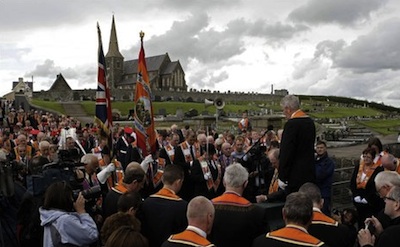
drumcreeorangebig.jpgA decision to allow the anti-Catholic Orange Order to gather in a public park surrounded by Catholic homes in Portadown has been described as ‘an act of unionist political madness’ by the Garvaghy Road Residents Coalition (GRRC).

Monday, May 13, 2013

CROMWELL'S LANDGRABBERS ; To Hell or To Connacht


A 300-year-old map of the transfer of landownership went online today. The Down Survey of Ireland, which has been uploaded by the history department in Trinity College, was of the forced Cromwellian plantation between 1656 and 1658.


The project to bring the map online was led by professor of modern history at Trinity College Dr Micheál Ă“’SiochrĂş, along with a team of historians who traced over 2,000 copies of the original survey maps from libraries and archives.
Mr Ă“’SiochrĂş said the map’s website is an extraordinary and unique resource of early modern Irish history, which will completely change our understanding of 17th century Ireland.
“Preliminary research based on on-going work suggests that our understanding of the scale and timing of the massive transfer of land from Catholic to Protestant landholders will need to be reassessed,” he said.
“The bringing together of this highly detailed map collection and related contemporaneous material with the aid of GIS technology allows us to reconstruct this period of Irish history. It will be of great interest to historians, genealogists, sociologists, engineers and anyone with an interest in Ireland, its past and its people.”
The website is downsurvey.tcd.ie , will allow users to explore 17th century Ireland in detail through use of GIS technology. Site visitors will also be able to search a database of 10,000 landowners. It is definitely recommended.


Cromwell, Oliver: To Hell or to Connaught


Oliver Cromwell spent nine months in Ireland subduing by force most of the resistance to English rule. However, the job would not be complete to Cromwell’s satisfaction until Ireland was secure for all time as part of the Commonwealth of England , Scotland and Ireland . To finish his work, Cromwell returned to England to start the legislative suppression of Ireland while his son Henry Cromwell completed the military campaign. Cromwell and the Parliament passed the Act of Settlement of Ireland in 1653 whose goal was the massive transfer of land from Irish hands to English hands. The map in this article shows the plantation plan for Ireland , including pushing “the habitation of the Irish nation” to Connaught and Clare, giving the still resisting Irish the choice to go “To Hell or to Connaught .”


To complete his work in Ireland , Cromwell had several pressure groups to satisfy. One powerful group was the Adventurers who had bought acreage in Ireland on speculation in the early 1640s. Their investment was authorized by an act which declared forfeit 2,000,000 acres of Irish land as punishment for the rising of 1642. These Adventurers, called so because theirs was a risky investment in an adventure which was highly unpredictable, were able to buy up Irish land cheaply, for example £300 for 1000 acres in Connaught and £450 for 1000 acres in Munster . Cromwell was himself one the investors in debentures on Irish land. Another very important group to keep satisfied was the Ironsides, Cromwell’s army, who were owed arrears in pay which he had told them would be paid in Irish land. Once settled in Ireland , these hardened troops provided England with an occupying army. In 1652, when England declared that hostilities were over, there were 30,000 English soldiers in Ireland .


Where would Parliament get the land for these settlements? The Act of Settlement contained a list of the condemned whose land would be forfeit. Irish soldiers were given a choice of death or exile. The reputation of Irish troops as fierce fighting men made them desirable recruits for armies in continental Europe . France , Poland , Italy and Spain were some of the nations which sent recruiters to Ireland to bring back Irish young men for their armies. Between 1651 and 1655, 40,000 young Irish men left their homeland never to return. Their lands were forfeited.


The clergy was yet another source of acreage. Not only did the churches have land that could be confiscated, but also the Roman Catholic priest was regarded by the Puritan Parliament as an arch enemy. Cromwell’s people regarded priests as subversive since they had stayed with their flocks during all of Ireland ’s conflicts with England . The clergy were key, too, in achieving the English goal of making Ireland Protestant. By reducing the number of priests and by prohibiting the celebration of the Mass, Parliament hoped that Catholicism would wither and die away in Ireland . To effect such a change, Parliament placed a bounty of £20 for the arrest of a priest and made assisting a priest a capital crime. Priests were encouraged to accompany soldiers who left for other lands, and others were simply killed or transported. One of the internment camps set up for Irish Catholic priests was on the island of Inisbofin off Galway .

Most of the land which Cromwell needed to settle Ireland was taken from landowners who “... had not manifested constant good affection to the interest ... of England .” This group and noblemen like Lord Inchiquin, who had taken leadership roles in Irish conflicts out of loyalty to the crown, could not be trusted by England to have power and wealth in the new Ireland. Once the land was taken from these estates, it would be redistributed to the settlers. The landless Irish would be forced to move west, to settle in places like the Burren in Clare known “to have not wood enough to hang a man, water enough to drown him, nor earth enough to bury him.” The price the Irish paid for Cromwell’s settlement was dear, but the price the English paid may have been even more dear: “... the price he [the Irishman] had to pay for his life also purchased his enmity for generations yet to come. Within the very wording of the Ordinance were to be found the seeds of its own destruction.” (D.M.R. Esson in The Curse of Cromwell).

The map of Ireland showing the hurtful and cruel settlement of Ireland was a well thought out theoretical plan of diabolic inspiration. Looking at the map from east to west, a reader can see that the least able to resist another Irish rising, i.e., wounded veterans and the widows of those killed in action, were given land in the north of Dublin County and a small portion of Cork around Youghal. The original Pale around Dublin , over the years the securest area in Ireland for the English, was to be extended south from Dublin to include Kildare, Wicklow, Carlow and Wexford. Thought to be relatively secure in their proximity to Dublin and the Irish Sea , these counties were to be for the “special planting” of friends of Parliament.

Acting as a buffer between the Irish internment counties on the west and protecting the counties on the east, the counties Limerick, Tipperary , Waterford , Kings (Offaly), Queens (Laois), and Westmeath, Armagh , Antrim and Down were settled by both soldiers and Adventurers. Louth was given exclusively to the Adventurers. The soldiers had control of Kerry, Kilkenny, Wexford, Cavan, Monaghan, Fermanagh, Tyrone and Londonderry . They also received as arrears compensation the counties Longford, Leitrim, Donegal and Wicklow. Parts of Mayo and all of Sligo went to the soldiers, as they were on the border of the western counties of Irish internment.

All of Clare, Galway , Roscommon and most of Mayo was reserved as an enclave for the surviving Irish. The English plan was to pen in the Irish west of the Shannon River , which was seen as a defensible border, with the ocean to the west. Where the Shannon was not available in the northwest, the military settlement would seal this area. All of the islands off the coast of the enclave were cleared of the Irish or used for special purposes, such as the internship camp for priests on Inisbofin. Inside this prison without bars the English hoped to make the hardcore Irish leadership impotent, there being no ports, no war industries, no fortresses, and no natural defenses. All confiscated land was to be transferred on 26 September 1653 and all unauthorized Irish were to be in Connaught or Hell by 1 May 1654.

Cromwell and Parliament should have known better; theirs was a mad plan for both England and Ireland . Many of the officers and soldiers who were given land were not farmers nor desirous of living in Ireland . The Adventurers were investors in land, not even gentlemen farmers. Within ten years, only one-third of the new settlers remained in Ireland . The value of the Irish tenant farmers and laborers found new respect among the new settlers for their skills with the land. All kinds of schemes and delaying tactics were invented to get exceptions for the Irish who were either needed to work the land or who wished to avoid wild Connaught and its ancient residents who had no special reason to be welcoming to new comers.

The Settlement terms were never fully carried out, but enough was accomplished to embitter English - Irish relations for three hundred years and more. The Cromwellian settlement crushed the Irish economy by denuding Ireland of its natural forests by making timber a cash crop, by reducing its cattle wealth from a worth of £4 million in 1641 to £½ million in 1660, by erasing the production of milk, butter, oatmeal, oat bread, and meat to be replaced by dependence on the potato, by driving Irish vessels from commerce through laws requiring English only shipping, by reducing Irish Catholic land ownership from 60% in 1641 to 9% in 1660. Little wonder that an angry Ireland seething under English colonial rule rose up again and again to claim its independence. In his biography of Oliver Cromwell, John Morley assesses Cromwell’s place in Irish history in these words:“...to everyone it will at least be intelligible how his name has come to be hated in the tenacious heart of Ireland . What is called his settlement aggravated Irish misery to a degree that cannot be measured, and before the end of a single generation events at Limerick and the Boyne showed how hollow and ineffectual, as well as how mischievous, the Cromwellian settlement had been.”

And Cromwell himself? He died in 1658 and was buried with kings in Westminster Abbey. But by 1660, the king was back on the throne, and by 1661 Cromwell’s body was exhumed from the Abbey, and his head was placed on a pole in front of Westminister Hall. Sic Semper Tyrannis.

 by John Walsh originally published in April 2004

© Irish Cultural Society of the Garden City Area


Ireland in the 1650s lay in ruins. Twelve years of calamitous warfare had destroyed the country's infrastructure and resulted in the death of over 20% of the Irish population.

Mapping a Century of Change


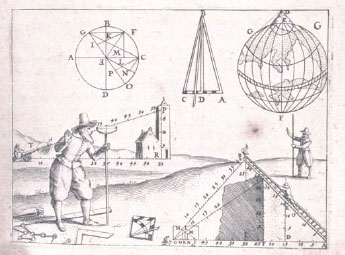
The armies of the English Commonwealth, commanded by Oliver Cromwell, emerged victorious and immediately undertook an ambitious project of social engineering, underpinned by a massive transfer in landownership from Irish Catholics to English Protestants. For this to happen, the land had to be accurately surveyed and mapped, a task overseen by the surgeon-general of the English army, William Petty.

The Down Survey of Ireland

Taken in the years 1656-1658, the Down Survey of Ireland is the first ever detailed land survey on a national scale anywhere in the world. The survey sought to measure all the land to be forfeited by the Catholic Irish in order to facilitate its redistribution to Merchant Adventurers and English soldiers. Copies of these maps have survived in dozens of libraries and archives throughout Ireland and Britain, as well as in the National Library of France. This Project has brought together for the first time in over 300 years all the surviving maps, digitised them and made them available as a public online resource.

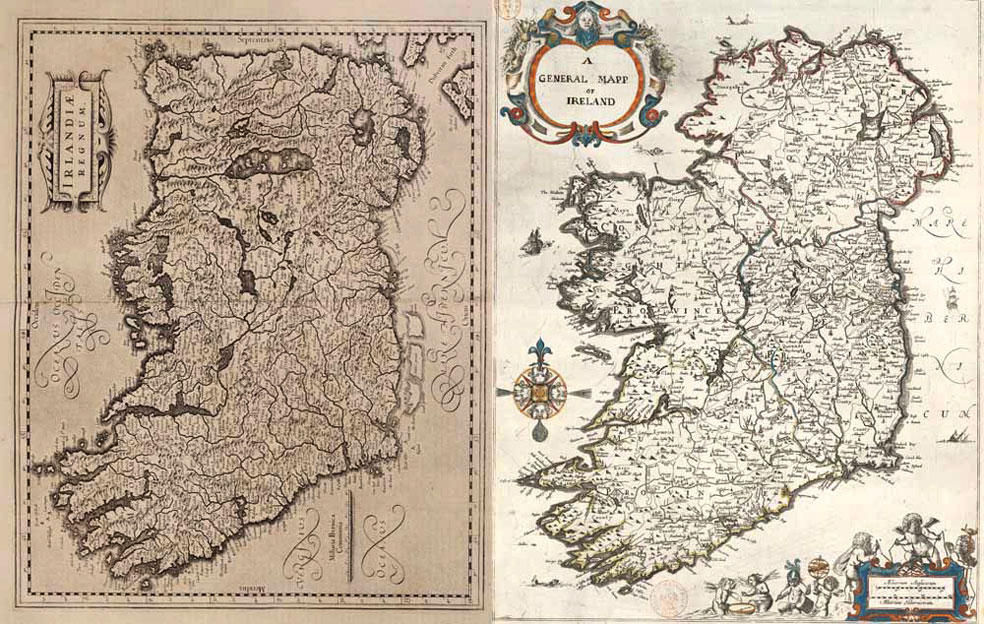
Ireland, the Mercator map of 1570 and the Down Survey map

The Down Survey Website

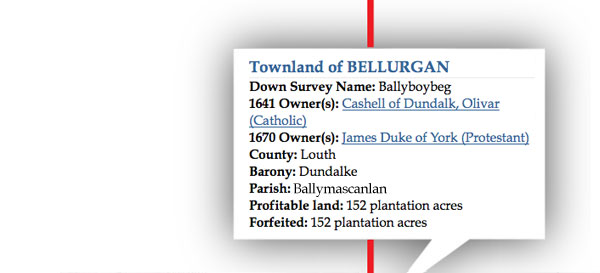
There are two main components to this website. The Down Survey Maps section comprises digital images of all the surviving Down Survey maps at parish, barony and county level. The written descriptions (terrier) of each barony and parish that accompanied the original maps have also been included. The second section, Historical GIS, brings together the maps and related contemporaneous sources – Books of Survey and Distribution, the 1641 Depositions, the 1659 Census – in a Geographical Information System (GIS). All these sources have been georeferenced with 19th-century Ordnance Survey maps, Google Maps and satellite imagery.

Barony Map

Down Survey Data

Down Survey County Map

Google Map

Satellite Image

Georeference Co-ordinates
A Geographic Information System (GIS) integrates hardware, software, and data for capturing, managing, analyzing, and displaying information that may be geographically referenced. GIS allows us to view visualise data in ways that reveal relationships, patterns, and trends in the form of maps or charts.

FriendFeed

IrishBlog

Twitter follow

THE WIND THAT SHAKES THE BARLEY IN IRELAND - SHARE

Share/Bookmark

Facebook Badge

Facebook

BOBBY SAND'S COMRADES TORTURED AGAIN OCCUPIED IRELAND

BOBBY SANDS COMRADES TORTURED AGAIN OCCUPIED IRELAND -http://... on Twitpic

Fwicki

Fwicki - RSS Management, Multimedia Data Portals, Syndication Consulting Services

YouTube

Friendconnect

javascript

Subscribe

Enter your email address:

Delivered by FeedBurner

networkedblogs

Search This Blog

AllVoices

Iraq Death Estimator

Iraq Deaths Estimator

ShareThis

NEWS you WON"T find on the BBC

LinkWithin

Related Posts with Thumbnails

BlogCatalog

Music Blogs - BlogCatalog Blog Directory

Irish Blogs

theBestLinks

Watch favourite links

LinkWithin

Related Posts with Thumbnails

Slashdot

Subscribe to updates

Share on Friendfeed

FriendFeed badge

Irishblogdirectory

Irish Blog Directory

My Headlines

Subscribe Now: Feed Icon

Newstrust

irishblogs

Irish Blogs

Subscribe Now: Feed Icon

Subscribe via email

Enter your email address:

Delivered by FeedBurner

My Headlines

My Headlines

Twitter Updates

    follow me on Twitter

    My Headlines

    Ireland Headline Animator

    Slashdot

    PLEASE RE-TWEET THIS BLOG !

    My Headlines

    Newstrust

    Follow Blog

    IrelandYouTube Headline Animator

    Subscribe Now: Feed Icon

    TweetIt

    My Blog List

    Followers

    Blog Archive