Irish Time

Sunday, July 14, 2013

UK TAXPAYER CASH COW MILKED BILLIONS BY MI5 BRITISH OCCUPIED IRELAND

UK TAXPAYERS CASH COW MILKED FOR BILLIONS BY BRITISH OCCUPIED IRELAND


Snowden's leaks have uncovered not only the UK government's unwarranted surveillance - but also the extent internet and telecom giants have helped them do it. They're accused of using the chance to cash in on taxpayers who are stumping up the cash. Snowden's latest leak particularly highlights Microsoft. The computer firm allegedly installed backdoor access to its services - exclusively for government surveillance. If that's the case - Microsoft's denial that it handed over data would still be true, because the government wouldn't even need to ask. Ray McGovern, a retired CIA officer, says this perfectly highlights the problem.


 Regarded by many to be the best version of the great Tommy Makem's signature song. This recording was played at the Tommy Makem memorial concerts at the Irish festivals summer 2007, shortly after Tommy died on August 1, 2007. The poem at the beginning is "Requiem for the Croppies." Feb 6, 1983, At the National Concert Hall, video companion to the album of the same name.Tommy was born and raised in Keady, County Armagh, Ireland (the "Hub of the Universe" as Makem always said).His mother, Sarah Makem, was an important source of traditional Irish music, who was visited and recorded by, among others, Diane Guggenheim Hamilton, Jean Ritchie, Peter Kennedy and Sean O'Boyle. His father, Peter Makem, was a fiddler who also played the bass drum in a local pipe band named "Oliver Plunkett", after a martyr of the Cromwell age. His brother and sister were folk musicians also. Young Tommy Makem, from the age of 8, was member of the St. Patrick's church choir for 15 years where he sang Gregorian chant and motets. He didn't learn to read music but he made it in his "own way".


Martin Corey an innocent old man, interned three years without trial, a political scapegoat, to justify MI5's  milking the UK taxpayer cash cow, for billions, at its state of the art Hollywood base, in British Occupied Ireland.

See Link for Details : www.releasemartincorey.com

Saturday, July 13, 2013

ORANGETANS GO APESHIT BRITISH OCCUPIED IRELAND


“THE POWER DRUG”
An in-depth analysis of
Stanley Kubrick’s
A CLOCKWORK ORANGE
Text copyright © by Rob Ager 2010


CHAPTER FOUR
THE NEW PSYCHEDELIC FASCISM
Kubrick rarely engaged in published exchanges with his critics. His silence alone tended to render his detractors as irrelevant. For the most part he kept this up even during the controversy over ACO, where as most film makers would be out shouting about the merits of their work and the nobility of their intentions.
However, there was a notable exception. The heavyweight political writer Fred M. Hechinger wrote an attack on Kubrick’s ACO, claiming that the film supports fascism. The full article by Hechinger can be read at this link (scroll to the bottom portion of the linked page) on the excellent Kubrick Site. Personally, I found the article to be typically vague political rhetoric – high on ideological posing and almost completely lacking in supporting evidence.
However, people often rate arguments based upon who is speaking rather than what is being said. Probably being well aware of this, Kubrick took Hechinger on publicly like a chess opponent. His lengthy response letter, published in the New York Times in 1972, puts Hechinger’s arguments succinctly into the context they deserve. He cites Hechinger’s second hand writing approach(his regurgitation of other journalists’ work without any original research or direct reference to the source film content), his“alarmist” opposition to artists’ free speech and promotion of censorship, and examples of other respected journalists’ and political writers who had written articles completely at odds with Hechinger’s assertions. In citing such a variety of literary sources Kubrick further revealed his own fascination with philosophy, politics and social sciences. Kubrick’s full response can also be read at the above link to the Hechinger article and was published again in the Stanley Kubrick Archives book.
Getting back to our task here, there is a particular section of Kubrick’s response to Hechinger in which the director explicitly reveals one of ACO’s social themes.
Hechinger is probably quite sincere in what he feels. But what the witness feels, as the judge said, is not evidence -- the more so when the charge is one of purveying "the essence of fascism."
"Is this an uncharitable reading of...the film's thesis?" Mr. Hechinger asks himself with unwonted if momentary doubt. I would reply that it is an irrelevant reading of the thesis, in fact an insensitive and inverted reading of the thesis, which, so far from advocating that fascism be given a second chance, warns against the new psychedelic fascism -- the eye-popping, multimedia, quadrasonic, drug-oriented conditioning of human beings by other beings -- which many believe will usher in the forfeiture of human citizenship and the beginning of zombiedom.
ACO is, in part, a warning against the hedonistic dumbing down of society or, in Kubrick’s words, “the new psychedelic fascism”. Undoubtedly, this theme contributed to Kubrick’s aesthetic choices in set and prop design. The resulting variety of sexually surreal“art” in the film doesn’t feature in Burgess’ book.
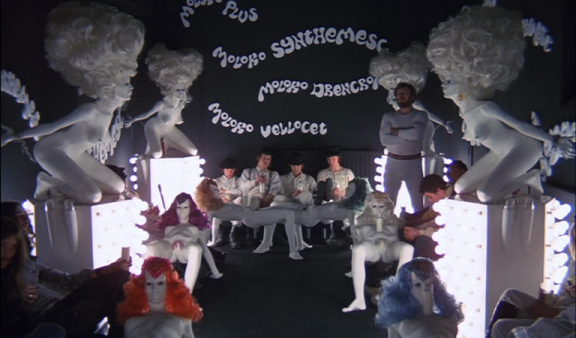
First up we have the most obvious examples, spanning across three scenes. There’re the fibre-glass naked women, moulded in sexually subservient positions, in the Korova Milk bar.
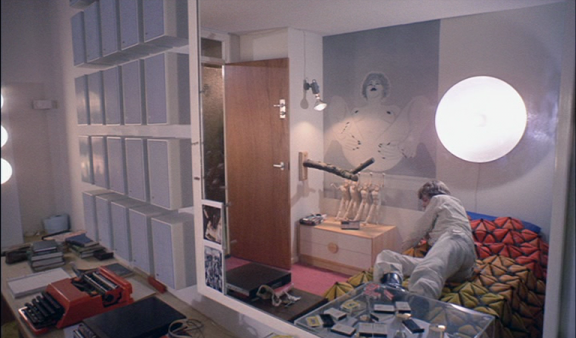
There’s the, verging on pornography, painting of a naked woman in Alex’s bedroom. Note the phalic branch sticking from the wall. It is positioned as if penetrating the woman in the painting. In a later shot Alex's snake is coiled around this branch and sniffs at the genitalia of the woman in the painting.
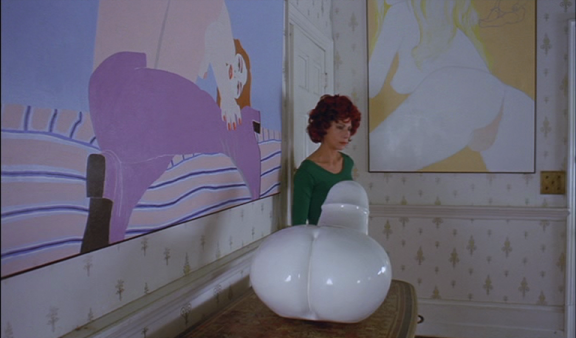
And there’s the Cat-lady’s collection of pornographic paintings and her phallic sculpture.
These art-porn features are another variation on the hypocrisy themes.
In the Cat-lady’s gym, our first close up view of the phallic sculpture is placed directly beneath a painting of a naked woman (see screenshot above). The composition reveals an interesting parallel. The testicles at the back of the sculpture are shaped like the buttocks of the woman in the painting. The woman and sculpture are both painted plain white and the woman has her back arched upward, just as the phallic end of the sculpture is arched upward. The sculpture is a fusion of the female figure and male genitalia.
One of the Cat-lady’s more surreal paintings features a woman masturbating as she holds in her free hand a small man in a white suit, black hat and white boots. The man appears to be dressed in the same outfit as Alex and his droogs.
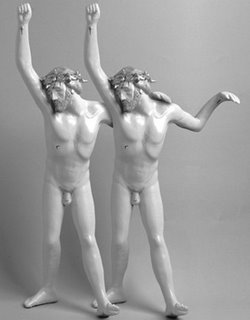
The implication here is that Mrs Weathers, the Cat-lady, has a sexual nature identical to Alex’s. Her penis sculpture, which she angrily claims to be “a very important work of art” represents a reversal of sexual dominance – a naked woman as a large, imposing, erect penis. This all parallels directly with the pornographic art and Dancing Jesus sculptures featured in Alex’s own bedroom.
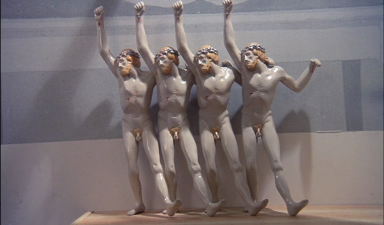
The Jesus figures are called Christ Unlimited and were designed by Herman Makkink.
Note that they don't necessarily come as a set of four - many can be linked together in a chain. Kubrick's choice of four Christ Unlimited figures for the scene parallels the four droogs of Alex's gang. These Christ droogs each hold one hand up above them, much like the masturbating lady in Mrs Weather’s painting. The figures symbolically come to life in a series of close up shots, as if dancing just as Alex and his droogs did when attacking the writer and his wife.
Mrs Weathers, in her leg stretching aerobic position, imitates the sexually dominant women in her own paintings (note that the painting of a woman in purple boots appears to be doing some sort of stretching exercize combined with sexual exhibitionism on a mattress).
When Alex hits Mrs Weather with the sculpture she is in a similar exercize position as she was at the beginning of the scene. The violence from Alex is even inter-cut with several flash frames of her paintings.
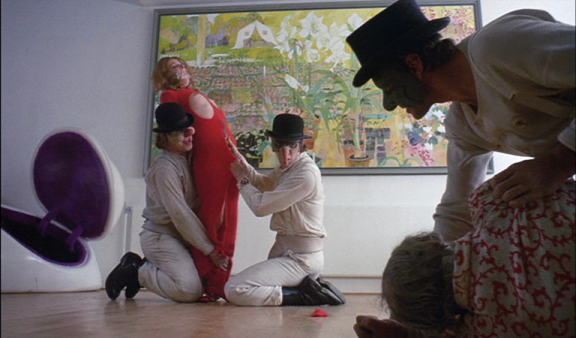
Another painting in the Cat-lady’s gym shows a woman with the breasts cut out of her clothing and a sash around her mouth. This is a repeat image of the writer’s wife, prior to being raped by the droogs, who incidentally was stood by a painting.
Broadly, the art work in the Cat-lady's gym communicates a simple theme – the Cat-lady shares Alex’s sexual dominance fantasies and both characters consider their expression of such impulses to be a form of art.
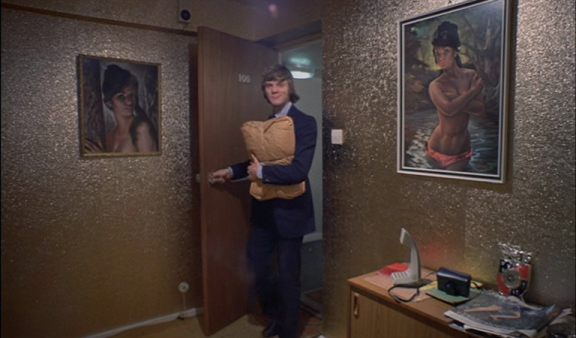
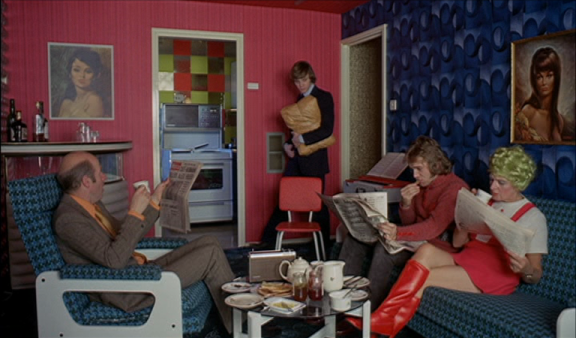
At a more subtle level, we even find an indulgence of pornography from Alex’s parents, one that is paralleled in the Cat-lady’s house. After returning from prison, Alex enters the apartment. On either side of him are two paintings of alluring women by J.H. Lynch and in the living room are two more mildly erotic paintings by the same artist.
The picture right screen, as Alex enters the apartment, is called “Nymph” and beneath is a phallic shaped telephone aimed in the painting’s direction, next to a mildly erotic picture of a woman in a magazine (the phone prop certainly isn’t accidental, as we’ll discover in a later chapter). The “Nymph” is stood in thigh deep water, as is a naked woman in the painting directly above Mrs Weathers’ telephone. Although the Cat-lady's phone isn’t phallic shaped, a bust of Beethoven stands erect beneath the painting instead. The Cat-lady uses this phallic ornament to attack Alex, to which he responds by hitting her back with a more obvious phallic ornament.
These symbols demonstrate that sexual exhibitionism isn’t unique to young thugs such as Alex. The celebration of sexual impulses is a wider social phenomena that crosses class and age boundaries.
This masquerading of hardcore pornography as art is revealed more bluntly as Alex listens to Beethoven in his bedroom. He sits staring at the Dancing Jesus figures and a painting of a naked woman with her legs spread wide open, his face flushed, his eyes popping out and a slow back and forth movement of his left shoulder. It doesn’t take much imagination to realize what Alex is doing. This innuendo was also present in Burgess, book …
As I slooshied, my glazzies tight shut to shut in the bliss that was better than any synthemesc Bog or God, I knew such lovely pictures. There were vecks and ptitsas, both young and starry, lying on the ground screaming for mercy, and I was smecking all over my rot and grinding my boot in their litsos. And there were devotchkas ripped and creeching against walls and I plunging like a shlaga into them, and indeed when the music, which was one movement only, rose to the top of its big highest tower, then, laying there on my bed with my glazzies tight shut and rookers behind my Gulliver, I broke and spattered and cried aaaaaaah with the bliss of it. And so the lovely music glided to its glowing close.
… but is taken further by Kubrick with a series of symbolic images that Freud or Hitchcock would have been proud of.
  • A woman being hung from a gallows (this is a stock shot from the film Cat Ballou)
  • An explosion of Earth
  • A moving train exploding
  • Alex as a vampire
  • Cavemen being crushed by rocks from an erupting volcano (this shot is taken from the 1966 film One Million Years B.C. and can be seen in this trailer).
  • An eruption of hot lava
The fusion of art and pornography has certainly reached and surpassed ACO’s warnings in the real world. Today thousands of MTV videos bombard adults and children with images of near naked men and women, flaunting their sexuality and rubbing their bodies together in competing gestures of sexual dominance. Pre-pubescant girls imitate these dress fashions and dance routines, while singing lyrics laced with erotic innuendos. The production and distribution of pornography is a massive industry that gets little mention in the press, perhaps because even tabloid newspapers are getting in on the act by incorporating soft porn into their pages.
We have been immersed in this new tasteless society for decades. Intellect and morality are devalued in favour of hedonism and sexual ego. In ACO, as in our world today, the tasteless indulgence extends into fashion, décor and architecture. Women, including Alex’s mother and the psychiatrist who quizzes Alex in hospital, dress and die their hair in over-bearing and mismatching colours. The bootik, where Alex goes to buy records, is disorientating in its use of ceiling mirrors and floor to ceiling racks of pop imagery. The bootik location wasn’t even designed by Kubrick, it was a real location called The Chelsea Drugstore. Here is an excellent breakdown of props in the bootik scene by John Coulhart (we’ll return to Coulhart’s observations later). Perhaps Kubrick’s choice of this location wasn’t just about the look of the place, but also its name. Remember Kubrick’s description of “the new psychedelic fascism -- the eye-popping, multimedia, quadrasonic, drug-oriented conditioning of human beings by other beings”? Hedonistic art and music have become psychological drugs. The number one record listed in the top ten chart in the bootik is called Mass in G by Goggly Gogol.
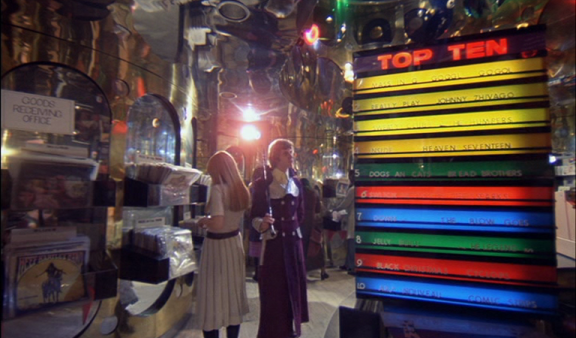
Mass in G may refer to a classical piece by Vaughan Williams, and may be Kubrick’s comment on how cheap, modern pop music has converted real music into assembly line imitation. Although we’re led to believe Alex has no interest in this music, this is the very same musical piece that he pulls from his cassette player before inserting his Beethoven tape.
Kubrick was also able to handpick real world examples of tasteless architecture – several of which are still standing today and are explored in this link at the Worldwide Guide to Movie Locations website.
The age of eye-popping psychedelia has been upon us for decades and it can certainly be argued that new technology and cheap forms of media distribution are the cause of it, but Kubrick’s description of a New Psychedelic Fascism is a harsher view. Rather than describing the use of such psychedelia as some sort techno-political conspiracy to dumb down the masses, Kubrick may have simply been referring to the mass distraction effect of such media, which draws the attention of citizens away from the activities of potentially fascist governments – thus facilitating the gradual re-emergence of fascism.

Friday, July 12, 2013

SHALL MY SOUL PASS THROUGH OLD IRELAND

SHALL MY SOUL PASS THROUGH OLD IRELAND


 "Unless a grain falls to the ground"

There was a common saying in Ireland years ago, “McSwiney taught us how to die!”, referring to Terence McSwiney, the Mayor of Cork, who died in a British Gaol in 1920, at the height of the Irish war of Independence, after 74 days on hunger strike.  

His Hunger strike made headlines all around the world.   Terence McSwiney is also remembered for saying: “It is not those who can inflict the most, but those who can suffer the most who will prevail." This is certainly true of Martin Corey, a political prisoner of conscience currently interned without trial in British Occupied Ireland.

Martin has spent more that 3 years now interned without trial, following a previous term of more than 19 years in Long Kesh Concentration Camp. Martin is absolutely innocent in this instance and simply a scapegoat for the British to make an example of against other Irish ex-political prisoners who may contemplate joining an Irish Republican Party.

Martin as a member of Republican Sinn Fein, has not been engaged in any militant activity what so ever. Martin Corey is a political prisoner of conscience, simply because of his beliefs in a united Island of Ireland with economic justice and freedom for its people of no property. This is something the British and their agents must censor, bury in secret courts, intern without trial in British Occupied Ireland.


After McSwiney was elected to the mayoralty. He was arrested in Dublin on August 12th, 1920 and charged with making a ‘seditious’ speech; with possession of a police code and a Cork Corporation resolution recognising Dáil Éireann. McSwiney immediately commenced a hunger strike. He was tried by court-martial, found guilty and sentenced to two years imprisonment. In Brixton Prison, McSwiney continued his hunger strike for seventy-four days until his death on October 25th, 1920. This was the longest hunger strike in Irish political history.


The young Ho Chi Minh, then a dishwasher in London, said of McSwiney – ‘A Nation which has such citizens will never surrender’. McSwiney’s body lay in state in the Southwark Cathedral, London before removal by sea to Dublin and then by train to Cork. His funeral procession was one of the largest ever seen in Cork City. In 1921 McSwiney’s play The Revolutionist was produced at the Abbey Theatre, Dublin.
 
Terence McSwiney Memorial Card
(Go raibh maith agat J.L.)

This extract is from Terence McSwiney’s Principle of Freedom (1921). ©
Why should we fight for freedom? Is it not strange, that it has become necessary to ask and answer this question? We have fought our fight for centuries, and contending parties still continue the struggle, but the real significance of the struggle and its true motive force are hardly at all understood, and there is a curious but logical result. Men technically on the same side are separated by differences wide and deep, both of ideal and plan of action; while, conversely, men technically opposed have perhaps more in common than we realise in a sense deeper than we understand.

This is the question I would discuss. I find in practice everywhere in Ireland – it is worse out of Ireland – the doctrine ‘The end justifies the means’.
One party will denounce another for the use of discreditable tactics, but it will have no hesitation in using such itself if it can thereby snatch a discreditable victory. So, clear speaking is needed: a fight that is not clean-handed will make victory more disgraceful than any defeat. I make the point here because we stand for separation from the British Empire, and because I have heard it argued that we ought, if we could, make a foreign alliance to crush English power here, even if our foreign allies were engaged in crushing freedom elsewhere.

When such a question can be proposed it should be answered, though the time is not ripe to test it. If Ireland were to win freedom by helping directly or indirectly to crush another people she would earn the execration she has poured out on tyranny for ages. I have come to see it possible for Ireland to win her independence by base methods.

It is imperative, therefore, that we should declare ourselves and know where we stand. And I stand by this principle: no physical victory can compensate for spiritual surrender. Whatever side denies that is not my side…

A SPIRITUAL necessity makes the true significance of our claim to freedom: the material aspect is only a secondary consideration. A man facing life is gifted with certain powers of soul and body. It is of vital importance to himself and to the community that he be given a full opportunity to develop his powers, and to fill his place worthily. In a free state he is in the natural environment for full self-development. In an enslaved state it is the reverse. When one country holds another in subjection that other suffers materially and morally. It suffers materially, being a prey for plunder. It suffers morally because of the corrupt influences the bigger nation sets at work to maintain its ascendancy. Because of this moral corruption national subjection should be resisted, as a state fostering vice; and as in the case of vice, when we understand it we have no option but to fight. With it we can make no terms. It is the duty of the rightful power to develop the best in its subjects: it is the practise of the usurping power to develop the basest.
Our history affords many examples. When our rulers visit Ireland they bestow favours and titles on the supporters of their regime – but it is always seen that the greatest favours and the highest titles are not for the honest adherent of their power – but for him who has betrayed the national cause that he entered public life to support.

Observe the men who might be respected are passed over for him who ought to be despised. In the corrupt politician there was surely a better nature. A free state would have encouraged and developed it. The usurping state titled him for the use of his baser instincts. Such allurement must mean demoralisation. We are none of us angels, and under the best circumstances find it hard to do worthy things; when all the temptation is to do unworthy things we are demoralised. Most of us, happily, will not give ourselves over to the evil influence, but we lose faith in the ideal. We are apathetic. We have powers and let them lie fallow. Our minds should be restless for beautiful and noble things; they are hopeless in a land everywhere confined and wasted. In the destruction of spirit lies the deeper significance of our claim to freedom.


What, then, is the true basis to our claim to freedom? There are two points of view. The first we have when fresh from school, still in our teens, ready to tilt against everyone and everything, delighting in saying smart things--and able sometimes to say them--talking much and boldly of freedom, but satisfied if the thing sounds bravely. 

There is the later point of view. We are no longer boys; we have come to review the situation,  and take a definite stand in life. We have had years of experience, keen struggles, not a little bitterness, and we are steadied. We feel a heart-beat for deeper things. It is no longer sufficient that they sound bravely; they must ring true.

The schoolboy's dream is more of a Roman triumph--tramping armies, shouting multitudes, waving banners--all good enough in their way. But the dream of men is for something beyond all this show. If it were not, it could hardly claim a sacrifice.

Terence McSwiney

THE POGUES : BIRMINGHAM SIX ; Martin Corey

THE POGUES : BIRMINGHAM SIX Martin Corey


THE POGUES : Streets of Sorrow/Birmingham Six


Oh farewell you streets of sorrow

And farewell you streets of pain

I'll not return to feel more sorrow

Nor to see more young men slain

Through the last six years I've lived through terror

And in the darkened streets the pain

Oh how I long to find some solace

In my mind I curse the strain


So farewell you streets of sorrow

And farewell you streets of pain

No I'll not return to feel more sorrow

Nor to see more young men slain


There were six men in Birmingham

In Guildford there's four

That were picked up and tortured

And framed by the law

And the filth got promotion

But they're still doing time

For being Irish in the wrong place

And at the wrong time

In Ireland they'll put you away in the maze

In England they'll keep you for seven long days

God help you if ever you're caught on these shores

The coppers need someone

And they walk through that door


You'll be counting years

First five, then ten

Growing old in a lonely hell

Round the yard and the stinking cell

From wall to wall, and back again


A curse on the judges, the coppers and screws

Who tortured the innocent, wrongly accused

For the price of promotion

And justice to sell

May the judged by their judges when they rot down in hell


May the whores of the empire lie awake in their beds

And sweat as they count out the sins on their heads

While over in Ireland eight more men lie dead

Kicked down and shot in the back of the head


Martin Corey's Story Link :

http://www.releasemartincorey.com

Thursday, July 11, 2013

ORANGE APARTHEID ALIVE IN AFRICA & BRITISH OCCUPIED IRELAND


Mandela’s Greatness May Be Assured -- But

Not His Legacy

By John Pilger
July 11, 2013 "Information Clearing House -  When I reported from South Africa in the 1960s, the Nazi admirer Johannes Vorster occupied the prime minister’s residence in Cape Town. Thirty years later, as I waited at the gates, it was as if the guards had not changed. White Afrikaners checked my ID with the confidence of men in secure work. One carried a copy of Long Walk to Freedom, Nelson Mandela’s autobiography. “It’s very eenspirational,” he said.

Mandela had just had his afternoon nap and looked sleepy; his shoelaces were untied. Wearing a bright gold shirt, he meandered into the room. “Welcome back,” said the first president of a democratic South Africa, beaming. “You must understand that to have been banned from my country is a great honour.” The sheer grace and charm of the man made you feel good. He chuckled about his elevation to sainthood. “That’s not the job I applied for,” he said drily.

Still, he was well used to deferential interviews and I was ticked off several times – “you completely forgot what I said” and “I have already explained that matter to you”. In brooking no criticism of the African National Congress (ANC), he revealed something of why millions of South Africans will mourn his passing but not his “legacy”.

I had asked him why the pledges he and the ANC had given on his release from prison in 1990 had not been kept. The liberation government, Mandela had promised, would take over the apartheid economy, including the banks – and “a change or modification of our views in this regard is inconceivable”. Once in power, the party’s official policy to end the impoverishment of most South Africans, the Reconstruction and Development Programme (RDP), was abandoned, with one of his ministers boasting that the ANC’s politics were Thatcherite.

“You can put any label on it if you like,” he replied. “…but, for this country, privatisation is the fundamental policy.”

“That’s the opposite of what you said in 1994.”

“You have to appreciate that every process incorporates a change.”

Few ordinary South Africans were aware that this “process” had begun in high secrecy more than two years before Mandela’s release when the ANC in exile had, in effect, done a deal with prominent members of the Afrikaaner elite at meetings in a stately home, Mells Park House, near Bath. The prime movers were the corporations that had underpinned apartheid.

Around the same time, Mandela was conducting his own secret negotiations. In 1982, he had been moved from Robben Island to Pollsmoor Prison, where he could receive and entertain people. The apartheid regime’s aim was to split the ANC between the “moderates” they could “do business with” (Mandela, Thabo Mbeki and Oliver Tambo) and those in the frontline townships who led the United Democratic Front (UDF). On 5 July, 1989, Mandela was spirited out of prison to meet P.W. Botha, the white minority president known as the Groot Krokodil (Big Crocodile). Mandela was delighted that Botha poured the tea.
With democratic elections in 1994, racial apartheid was ended, and economic apartheid had a new face. During the 1980s, the Botha regime had offered black businessmen generous loans, allowing them set up companies outside the Bantustans. A new black bourgeoisie emerged quickly, along with a rampant cronyism. ANC chieftains moved into mansions in “golf and country estates”. As disparities between white and black narrowed, they widened between black and black.

The familiar refrain that the new wealth would “trickle down” and “create jobs” was lost in dodgy merger deals and “restructuring” that cost jobs. For foreign companies, a black face on the board often ensured that nothing had changed. In 2001, George Soros told the Davos Economic Forum, “South Africa is in the hands of international capital.”

In the townships, people felt little change and were subjected to apartheid-era evictions; some expressed nostalgia for the “order” of the old regime. The post-apartheid achievements in de-segregating daily life in South Africa, including schools, were undercut by the extremes and corruption of a “neoliberalism” to which the ANC devoted itself. This led directly to state crimes such as the massacre of 34 miners at Marikana in 2012, which evoked the infamous Sharpeville massacre more than half a century earlier. Both had been protests about injustice.

Mandela, too, fostered crony relationships with wealthy whites from the corporate world, including those who had profited from apartheid. He saw this as part of “reconciliation”. Perhaps he and his beloved ANC had been in struggle and exile for so long they were willing to accept and collude with the forces that had been the people’s enemy. There were those who genuinely wanted radical change, including a few in the South African Communist Party, but it was the powerful influence of mission Christianity that may have left the most indelible mark. White liberals at home and abroad warmed to this, often ignoring or welcoming Mandela’s reluctance to spell out a coherent vision, as Amilcar Cabral and Pandit Nehru had done.
Ironically, Mandela seemed to change in retirement, alerting the world to the post 9/11 dangers of George W. Bush and Tony Blair. His description of Blair as “Bush’s foreign minister” was mischievously timed; Thabo Mbeki, his successor, was about to arrive in London to meet Blair. I wonder what he would make of the recent “pilgrimage” to his cell on Robben Island by Barack Obama, the unrelenting jailer of Guantanamo.
Mandela seemed unfailingly gracious. 

When my interview with him was over, he patted me on the arm as if to say I was forgiven for contradicting him. We walked to his silver Mercedes, which consumed his small grey head among a bevy of white men with huge arms and wires in their ears. One of them gave an order in Afrikaans and he was gone.


Apartheid Did Not Die


Martin Corey Interned Without Trial. His 

Usual Lawyer in Lurgan Rosemary Nelson 

Blown Up by British Secret Service Agents 


John Pilger’s film, Apartheid Did Not Die, can be viewed on www.johnpilger.com

Apartheid Did Not Die


http://www.releasemartincorey.com

FriendFeed

IrishBlog

Twitter follow

THE WIND THAT SHAKES THE BARLEY IN IRELAND - SHARE

Share/Bookmark

Facebook Badge

Facebook

BOBBY SAND'S COMRADES TORTURED AGAIN OCCUPIED IRELAND

BOBBY SANDS COMRADES TORTURED AGAIN OCCUPIED IRELAND -http://... on Twitpic

Fwicki

Fwicki - RSS Management, Multimedia Data Portals, Syndication Consulting Services

YouTube

Friendconnect

javascript

Subscribe

Enter your email address:

Delivered by FeedBurner

networkedblogs

Search This Blog

AllVoices

Iraq Death Estimator

Iraq Deaths Estimator

ShareThis

NEWS you WON"T find on the BBC

LinkWithin

Related Posts with Thumbnails

BlogCatalog

Music Blogs - BlogCatalog Blog Directory

Irish Blogs

theBestLinks

Watch favourite links

LinkWithin

Related Posts with Thumbnails

Slashdot

Subscribe to updates

Share on Friendfeed

FriendFeed badge

Irishblogdirectory

Irish Blog Directory

My Headlines

Subscribe Now: Feed Icon

Newstrust

irishblogs

Irish Blogs

Subscribe Now: Feed Icon

Subscribe via email

Enter your email address:

Delivered by FeedBurner

My Headlines

My Headlines

Twitter Updates

    follow me on Twitter

    My Headlines

    Ireland Headline Animator

    Slashdot

    PLEASE RE-TWEET THIS BLOG !

    My Headlines

    Newstrust

    Follow Blog

    IrelandYouTube Headline Animator

    Subscribe Now: Feed Icon

    TweetIt

    My Blog List

    Followers

    Blog Archive