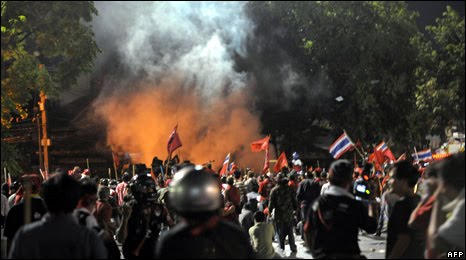
The Thai army yesterday shot one of its own on the streets of Bangkok. They have been ordered by the British born, Eton educated, unelected Prime Minister Abhisit, to shoot to kill unarmed civilians protesting in Thailand. The following is a link to a discussion in the pro-government media in Thailand, about what is happening in the background currently, between Eton Abhisit and the Army Chief of Staff General Anupong. All of the independent media sites numbering several thousand have been shut down with many sent to prison with long jail sentences. So remember its a pro-government and try to read between the lines.
To carry out such a policy of heartless murder on civilians, Eton teaches a culture of supremacy, of seeing poor and native people as sub-human and then demonizing them with their media mafia, before the many slaughters and massacres ordered by the Eton Rifles. It is heartless and merciless.
Remember Sharpeville
bullet-in-the-back day
Because it epitomized oppression
and the nature of society
more clearly than anything else;
it was the classic event
Nowhere is racial dominance
more clearly defined
nowhere the will to oppress
more clearly demonstrated
what the world whispers
apartheid with snarling guns
the blood lust after
South Africa spills in the dust
Remember Sharpeville
Remember bullet-in-the-back day
And remember the unquenchable will for freedom
Remember the dead
and be glad.
- Dennis Brutus
From Ireland their first colony to India to Pakistan, to the Middle-East, to the war ravaged continent of Africa, the Eton legacy continues with centuries of a policy to foster division and then conquer the people of no property, the peasants. Whether to antagonize racial or religious division for conquest, the Rifles of Eton educated on this supremacist basis, the British imperialists still cause mayhem on a daily basis while their educated and their heirs the Americans, carry on the tradition of the Butchers Apron, under a flag of the same colour and design.Now we have another Eton educated and British Abhisit, directing another Bloody Sunday and the creation of another civil war in Thailand.
Since 1946, when King Bhumibol Adulyadej came to the throne in Thailand at 18-years of age, the country has had nine military coups and more than 20 prime ministers. Only two constitutions of seventeen since the abolition of absolute monarchy ended and the introduction of a British style monarchy in 1932, have allowed parliaments that are entirely elected. The king, who is revered by many across the nation and protected from discussion by lese-majesty laws, has been in hospital since Sept. 19 without speaking publicly about the demonstrations.
The current Thai Prime Minister Abhisit Vejjajiva who was born in England, in the city of Newcastle, attended Eton College and Oxford University. Abhisit earler went to Satit Chula, an elementary school linked to Chulalongkorn University, Thailand’s oldest institution of higher learning. He moved back to England to attend Eton, founded by King Henry VI in 1440, and then Oxford. One of his friends is classmate, London Mayor Boris Johnson. He entered politics in 1992, a year after the military appointed his father to serve in the Cabinet following a coup.
Ordinary people say his elite British upbringing, makes him ill-suited to bridge glaring class differences, that forced him to declare a state of emergency for a second time yesterday and permit another silent coup by the army. Abhisit yesterday gave the military powers to scatter thousands of impoverished protesters, who after a month of rallies stormed Parliament, forcing politicians to flee by helicopter. Stocks fell the most in Thailand for almost six months today, with the SET Index down 3.5 percent at the close of trade in Bangkok.
Many of the red-shirted demonstrators are loyal to exiled Prime Minister Thaksin Shinawatra, a billionaire who won over the poor with extremely cheap healthcare and low interest loans. The mostly poor demonstrators, people of no property, angered by huge income differences, say Abhisit is the stooge of a privileged class of military officers, judges, bureaucrats and royal advisers that are above the law in Thailand.
“Abhisit’s Oxford British education is a liability,” says Suranand Vejjajiva, Abhisit’s cousin and a former spokesperson for Thaksin’s party. “He thinks that by implementing programs for the poor he can win them over, but he’s missing the point. They see him as the representative of the elite, and they’re angry about injustice.” Closing the people's TV station and websites underpin the double standards after anti-Thaksin rivals were allowed to seize Bangkok’s airports in 2008, said protest leader Weng Tojirakarn.
“We’re not afraid because what we’re doing is right,” he said, after Abhisit issued the emergency decree last night. “Even if they suppress us violently, they cannot stop what we believe.”
Sitting around a campfire in Chiang Rai province, Noonai Binsamun said Abhisit’s party draws up policies from the comfort of Bangkok’s air-conditioned rooms, rather than mingling up country with the poor to hear their grievances.
“We don’t need a higher education to tell right from wrong,” said Noonai, a 53-year-old rice farmer. “Abhisit can speak very well and has some good ideas, but he can’t change the double standards in society.”
In 2007, Abhisit’s Democrat party won just 6 of 176 seats in the north, home to 40 percent of Thailand’s 67 million people. Per capita income in those areas is about a third of that in Bangkok, where he won 75 percent of seats.The richest fifth of the population earn about 55 percent of the income while the poorest fifth get 4 percent.
Abhisit, who moved from his Bangkok residence to an army barracks last month, with security concerns, saying protesters have violated the constitution. The emergency decree bans gatherings of more than five people, allows detention without charge and gives all the military immunity from prosecution.
The military government today blocked access to websites of the opposition. The sites had been hosting live video and audio of speeches by leaders of the United Front for Democracy Against Dictatorship.
Abhisit who has never won a national election, was picked by the remaining politicians, after a court dissolved the pro-Thaksin ruling party in December 2008, for election fraud, coinciding with the seizure of Bangkok’s international airports by protesters wearing yellow, who support the middle-class elite, the military and Abhisit.
On the other hand Thaksin and his allies have won the past four elections. The former leader has organized protests from overseas, since fleeing a Thai jail sentence handed down in 2008 after the military coup.


.jpg)
.jpg)


