Irish Time

Thursday, October 11, 2012

Shity of London Villiers Villains Banksters Pirates War Criminals


By James Petras

October 11, 2012 "
Information Clearing House" -  Whenever financial swindlers prosper at the expense of investors or a bank jiggers interest rates to bugger their competitors or tax evaders flee fiscal crises or rent gouging petrol monarchies recycle profits or oligarchs pillage economies and drive millions to drink, drugs and destitution they find a suitable secure sanctuary in London.

They are wooed and pursued by big British realtors eager to sell them multi-million dollar estates, trophy properties and landmark mansions. Pompous and pretentious British academics convince them to send their progeny to six digit private schools, promising them that when they graduate they will be speaking English through their nasal cavities, rolling their r’s and mastering the art of eloquent but vacuous elocution. British governments, Labor Liberal and Conservative, in the best and most hypocritical legal traditions, fashion the legal loopholes to attract the biggest and wealthiest parasites of the world.

Crime Wave Sweeps City of London
A veritable crime wave[1] has invaded the City of London, where millionaire investment bankers cook the books for billionaire clients and bilk the Treasury to pay their fines and flout the Law. Courses in business ethics are obligatory at Oxford and Cambridge since it has become standard operating procedure for mega-swindlers to plead guilty ,to pay a fine and avoid jail and to solemnly promise to never, ever, flout the law….. until the next mega-deal.


London has become the center of global financial capital by engaging in long term large scale active collaboration with multi-billion pound drug, arms, people smuggling and sex-slave cartels. The “Brits” specialize in laundering funds from the Mexican, Colombian, Peruvian, Russian, Polish, Czech, Nigerian narco-kings. Albanian white slavers have their ‘private bankers’ at prestigious City banks with a preference for graduates of the London School of Economics. Bi-lingual Greek kleptocrats, lifelong billion dollar tax evaders, fleeing from their pillaged homeland have their favorite real estate brokers, who never engage in any sort of naughty ‘due diligence’ which might uncover improper tax returns. The City Boys with verve and positive initiative, aided and abetted by the hyper-kinetic “Tony” Blair’s open door policy to swindlers and saints of all colors and creeds, welcomed each and every Russian gangster-oligarch-democrat, especially those who paid cash for multi-pound ‘Olde English’ landmark estates’.

The London Sanctuary for the world’s richest plunderers and parasites offers unprecedented services, especially protection from extradition and criminal prosecution at the site of their crimes. Impartial British legal and judicial officials are experts in citing constitutional precedents that, in strict regard for the established legal order, uphold the denial of extradition, denying the legal and justice systems of every pillaged country and the cries of justice of the impoverished Irish, Russians, Greeks and Spaniards.
Real and feigned indignation among the highly moralistic City Boys and cynical grins among the experienced senior partners, greet the unruly victims of their guest billionaires. The impoverished masses demand that the British creditor banks should collect their debt payments from the accounts of the swindlers who received the loans, passed their debt to the public treasury and recycled their ill-gotten gains into their British accounts.


When the Saville dressed, swashbuckling swindlers cross swords with their counterparts, as when the venerable and respectable, Barclays Bank fixed the Libor to profit on the interest rate differentials, at the expense of other banks, the bankers all agreed the solution was to pay a 290 million pound fine, admit the crime and try to save a system which should “only” bilk the public treasury, retail investors and ‘market takers’. Barclay’s “crime” was, of course, poisoning the trough from which their peers and partners prosper.
The Barclay Boys of both sexes, outraged by the indecent finger pointing by the other City Boys, raised an issue which nobody could deny: they were not alone. HSBC, Standard Charter, the Royal Bank of Scotland, Lloyds of London and many other bankers of equal or lesser assets across the Atlantic were engaged in similar unethical, (daresay criminal) or at least questionable undertakings. They also paid fines and were duly chastised. The older and more experienced senior officers of the City sent internal memos to their brash PR underlings to stop this unseemly washing of soiled silk shirts in public; mutual denunciations created the false image that there was a crime wave running through the suites of the City of London.

Unfortunately, the British legal system is not merely protective of overseas billionaire swindlers, it is also accommodative, supremely vindictive and bending over frontward when it comes to requests for extradition from its “Special Partner” in Washington. Let it be an Islamic religious figure or an Australian whistleblower (Assange) and, in due haste, with the extradition papers in hand, “the bobbies” are ready to break embassy doors to facilitate compliance.

London: Pimping for Parasites:
The global economic crisis is a boon for London’s high end real estate corporations, as overseas millionaires and billionaires, tax evaders, political raiders of the public treasury, abandon pillaged economies and pour billions into mansions and penthouses. Super-rich rentier monarchists from the despotic Gulf States join Russian commodity speculators, and new rich Chinese sweatshop owners in bidding up London properties in prestigious postal codes in Belgravia (Ebury Street, Eton Place, and Eton Square) Knightbridge, Mayfair (Park Street). Corpulent Russian oligarchs and pious Saudi royalty loll in country estates in, Hertfordshire, Herefordshire and Cheshire overlooking their elegant English gardens and enjoy the purring and caresses of their very upscale British courtesans, in one or another of the two dozen bedrooms. The British government’s tolerance and open minded attitude to Russian and Albanian gangster oligarchs, whose bloody ascent to wealth can match any Sicilian godfathers, greases the wheels for the rise of what the Financial Times chooses to call, the real estate ‘industry’, bankrolled by the financial ‘community’ and aligned with the insurance ‘investors’.

The predators international, take their afternoon tea at 4 p.m., sherry at 6:30 p.m. They are entertained by the gossip of Her Majesty’s Court and the Queen’s Anniversary Celebration and indulge in the sporting life (soccer teams over polo horses). They cultivate a taste for culture. Accompanied by Oxbridge experts they shop for “collectibles” – paintings at Ordovas on Saville Row, Richard Nagy on Old Bond Street, Frank Auerbach at the Malborough, sculpture in Jean & Luc Baroni at St. James and jewelry shops for a Vacheron Constatin.

The Gulf oil oligarchs, who gouge exorbitant rents from energy poor African and Asian countries and Chinese and Indian billionaires who exploit hundreds of millions of Asian female factory workers and deny migrant workers residence, rest and health insurance, spent $9 billion pounds ($14.4 billion dollars) on central London houses in 2010-2011[2]. Between 2011 and mid-2012, 60 percent of the buyers in the prime central London market were foreign millionaires and billionaires[3].

The Cameron-Clegg regime demands sacrifice, austerity and belt tightening in Greece, condemning millions to destitution, suicide and desolation, even as it encourages the top 1% of Greek kleptocrats to “invest” and reside in central London’s exclusive neighborhoods. According to the IMF 56,000 Greek plutocrats are tax evaders[4]. According to a US study of their annual income, $28 billion Euros ($36 billion USD) is unreported[5]. Most of which is deposited in London banks or ‘invested’ in luxury property in Mayfair, Belgravia or thereabouts. If the illegal accounts were taxed or better still used to pay for the foreign debt, it would conform to Greek law, reduce the deficit and social cuts and perhaps revive the economy. But respecting Greek tax laws would mean fewer commissions for the real estate moguls at Savells, Marsh and Parsons, Knight Frank; less private accounts for HSBC and Barclay’s; less sales at the upscale art galleries; fewer patrons for the high end ‘escort’ agencies of both sexes.

Crime pays. FIRE[6] plays. Public hospitals close. Tuition rises. Private clinics and schools catering to the overseas oligarchs and their British partners flourish. Where’s “the crises”? Not to be found in central London, nor in the City; nor in the legal system; nor in the Special Forces. Bank swindlers flourish. Judicial litigation among oligarchs pays. Dirty mercenary wars in Afghanistan, Libya, Syria and elsewhere provide lucrative contracts for retired Colonel Blimps– in the best traditions of empire.

The crises? That’s for the other England outside of the City, with the wrong postal codes. Where workers crowd emergency rooms, where the poor await evictions in what were once council houses and where those who study and work can look forward to debt and dead end jobs.

God bless God damn London, the Parasites Paradise!
James Petras, a former Professor of Sociology at Binghamton University, New York, owns a 50-year membership in the class struggle, is an adviser to the landless and jobless in Brazil and Argentina, and is co-author of Globalization Unmasked 


Ireland Nationalizing Banks or Gobshites Saving Banksters


Ask any economist - and they will tell you that the housing crisis is still very real - and it's still one of the major headwinds for our economic recovery. Yet - in the last Presidential debate - there was virtually no attention paid to this crisis and the millions of Americans who are on the verge of losing their homes. Why is that? Well - it's because both candidates know that the one best solution to the mortgage crisis is to make the banksters take a hit. And - as anyone who's familiar with post-Citizens United politics knows - if you're in favor of a policy that's gonna hit Wall Street - and you want to be elected to political office - then you need to keep your mouth shut about it. And that's exactly what both men did.

But in Ireland - they're not afraid of the banksters. This year - the Irish government is expected to pass a law will force the banks to write down principal on their home loans, which will substantially lower monthly mortgage payments for struggling homeowners. Of all the nations hit by the global housing crisis - not a single one has taken bold steps to help homeowners at the expense of the banksters. But Ireland is trying to change that now. Here's what they're doing. They're changing their bankruptcy laws to make it easier for struggling homeowners to walk away from an underwater home mortgage. And when a homeowner declares bankruptcy this way, the bank gets nothing.
  • When Irish politicians start telling the public the truth about the nature of the money loaned to them by banks, that it is money that simply didn't exist before the loan agreement was signed, that it was "created" by the bank using the borrower's signature as collateral. That the borrower isn't equally entitled to create money out of nothing to pay it back. When they do this, I'll believe they are not afraid of or in the pockets of the banksters.
  • This is bullshit. Ireland's bankruptcy laws are currently amongst the most punitive. Debts stay with you for the remainder of your life. Your ability to obtain credit is permanently reduced. In contrast, the laws in the United Kingdom limit the effect of a bankruptcy on an individual's life to seven years. Ireland making the bankruptcy laws a little more lenient doesn't equate with them being unafraid of the banksters.
  • In Ireland, the government is afraid of the banksrers, but more afraid of the people
  • Comment removed
  • Ireland bought a share in the banks a large share, its now selling them off to the ESM all while the Government has told the banks to increase the mortgage interest rates so the banks can get back to profit.


Wednesday, October 10, 2012

LIB LAB


TEMPER-MENTAL MISSELAYNEOUS


UNA MULLALLY
FOR DECADES, much of the emphasis on the Irish language in the arts has been about preservation. But things are changing. The Irish language in contemporary arts is spreading beyond Gaeltacht areas and reaching new collaborators and a new generation.
This rather accidental movement might also in time call for new structures and organisations, but for now, the fragmented innovations seem to indicate that something more whole is happening.
Imram, the Irish-Language Literature Festival takes place from October 11th to the 20th, and offers a dynamic programme. There are familiar names participating: Louis de Paor, Dairena Ní Chinnéide, Micheál Ó Conghaile. And there are familiar names discussed: Pádraic Ó Conaire and Seán Ó Ríordáin among them. But there is a current of energy flowing through the festival that those used to the traditional narratives of the Irish language in the arts might be surprised by.
There is an indoor and outdoor multimedia installation by Ceaití Ní Bheildiúin; a dance piece called Ré written by Daithí Ó Muirí and choreographed by Fearghus Ó Conchúir; contemporary prose from Éilís Ní Anluain; the Mouth On Fire theatre company reading Beckett’s poetry in Irish; The Cohen Project sees poets Liam Ó Muirthile and Gabriel Rosenstock translate some of Leonard Cohen’s work into Irish, with Liam Ó Maonlaí, David Blake, Hilary Bow and the Brad Pitt Light Orchestra providing the music.
“I’m a great believer in pushing the boundaries of language, it has to reach out beyond the island,” Ó Muirthile says. “There are obviously problems, technical questions, issues of readership and literacy and these are huge issues, but when you’re engaged in a piece of work, you have to set those aside. The advantage of taking a model like Cohen is when you’re writing in Irish or any minority language, you’re constantly translating into that language. You’re going through a constant process of translation of all sorts.”
Ó Muirthile also has high praise for his collaborator. “Gabriel Rosenstock has been the great innovator in Irish in that he’s been searching for models outside the language for many years. And Gabriel is the great inspiration model for all of us.”
Next week, a two-day symposium is being held in Dublin aiming to “explore, challenge and provoke notions of contemporary arts practice in Irish.” The symposium, titled Fás agus Forbairt’ (Grow and Develop) is hoping to bring together contemporary artists who are currently working in Irish and artists who may speak Irish but whose work is in English.
“The intention is that three organisations who have an active interest in programming contemporary work in the Irish language come together to provide support to artists who are already working in the Irish language, and to artists who may not be, but who might speak Irish,” says Róise Goan, the director of the Dublin Fringe Festival. Cian O’Brien, artistic director of Project Arts Centre, and Niamh Ní Chonchubhair, the programme manager at Axis: Ballymun, have joined Goan in organising the conference. “We’re hoping to connect all those artists, hopefully provide inspiration and then pilot a commissioning scheme that promotes collaboration in making contemporary Irish arts.”
The organisers are hoping to award three commissions, which will then go on to showcase works in progress in March 2013 during Seachtain na Gaeilge. “Hopefully, if the projects are going somewhere interesting, they will present that work in the Fringe next year,” Goan says. “We don’t know what’s going to happen. It’s an experiment, but we feel it’s a worthwhile experiment. I think a lot of the problems come from the fact that in terms of mainstreaming Irish language arts, things need to be tried and tested.”
Ray Yeates, then the director at Axis in Ballymun and now Dublin City Council’s arts officer, blasted the sean nós form open in 2009 with Hip-Nós, performances of hip-hop, sean nós and spoken word in Axis that went on to Vicar Street.
“You have great people like Róise Goan, and Ray Yeates and Willie [White, director of the Dublin Theatre Festival] – they’re the next movement,” says Maggie Breathnach, the producer of TG4’s flagship arts programme Imeall, who spends most of her time running around the country surveying the frontlines of contemporary Irish arts.
“Arts is niche, Gaeilge is niche, and ultimately, you need to put bums on seats. They’re doing it slowly, but it’s happening. You see in schools now, it’s a string to your bow to have Irish in a way it didn’t used to be. It’s not necessarily that you’re going to automatically see an Irish play if you speak Irish, or go to a launch of an Irish book, but there is work in Irish, there is funding there, and people are taking the opportunities. But ultimately, the bigger stage is perceived to be the English language.”
Breathnach believes changing the perception of the Irish language in a contemporary arts setting should start at an early age. “In education, maybe it should start to be the case that kids are also educated in the language in an arts context and would then be interested in going to an Irish play. And you go to a play because of the quality of the play not the language. Look at Tromluí Phinocchio.”
Tomluí Phinocchio or Pinocchio – A Nightmare is a production by Moonfish Theatre that was lauded at this year’s Absolut Fringe and also showed at the Galway Theatre Festival. “Those girls are brilliant,” Breathnach says. “There’s really good stuff happening, but sometimes people think either they won’t go to something because ‘it’s an Irish show’, or if they are going, it’s ‘ar son na cúise’ [for the cause], so we need to show that there is a pincer movement that catches both the Irish language and quality.”
In music, the Kilas and the Ó Maonlaís were flying the flag for Irish-inflected contemporary music from the 1990s on, and that’s still the case. The annual Seachtain na Gaeilge Ceol compilation CDs feature contemporary Irish artists singing Irish-language versions of their songs. While the overall result might be nice, there’s a sense of tokenism about it, even if, on occasion, these songs are occasionally brought to a live setting.
But things are changing. Temper-Mental MissElayneous, an upcoming Dublin rapper, has a tendency to drop Irish rhymes into her raps accompanied by bodhrán instead of beats, namely with her track Cailín Rua. And Daithí, a Clare fiddle player who has managed to successfully fuse traditional strains with contemporary electronic music, recently sampled the singer Mary O’Hara in one of his tracks, a trick last pulled by Massachusetts band Passion Pit in their break-out single Sleepyhead.
From the Puball Gaeilge tent at Electric Picnic to Manchán Mangan’s theatre work, there is an edge to the Irish language in a contemporary artistic context, and that edge is growing as those in charge of funding continue to quietly seek out more non-traditional targets. But a new generation of artists also need to take the leap. Perhaps next week’s Fás agus Forbairt symposium will put a real structure around such tentative, yet quickening steps.

Tuesday, October 9, 2012

Che Guevara of Galway Ireland International


This is What Imperialism Does to Men
"In our condition as colonial slaves, we could not observe: that “Western Civilization” disguises behind its showy facade a picture of hyenas and jackals. That is the only name that can be applied to those who have gone to fulfill such “humanitarian” tasks in the Congo. A carnivorous animal that feeds on unarmed peoples. That is what imperialism does to men. That is what distinguishes the imperial “white man.”
By Ernesto Che Guevara


Che Guevara : The Legacy Endures
The 45th anniversary of the death Ernesto Che Guevara

By Syed Badrul Ahsan

October 09, 2012 "
Information Clearing House" - Ernesto Che Guevara was murdered in the Bolivian village of La Higuera on October 9, 1967. Caught a day earlier by Bolivian soldiers in the jungles near the village, 13 days into the siege he and his fellow guerrillas had been pushed into, Che was bound hand and foot and made to lie down on the floor of a classroom in a school. Near him lay the bodies of two of his murdered comrades. Tired and worn out and obviously in a state of humiliation, Che was subjected to systematic questioning by Bolivian officers as well as Felix Rodriguez, an agent of the United States Central Intelligence Agency. His self-esteem intact, the man who had with Fidel Castro caused the revolution in Cuba on New Year's Day in 1959 would not give anything away, save only to murmur, sadly, that he had failed.

The CIA agent Rodriguez, for all his antipathy to Che, seemed to empathise with him in his moment of defeat. At one point, he took Che outside and put his arms around the bedraggled guerrilla as a photographer recorded the scene on his camera. It was to be the last image of Che Guevara alive. Soon afterward, a ruffian named Teran, instructed to shoot Che below the face, fired at his leg. Che bit his wrist in order not to scream out in pain. Teran fired again and again. The last bullet, the ninth, hit Che in the throat. The blood filled his lungs. He was dead.

What followed once Che was killed remains a story that was to turn into a modern legend, almost of an epic sort. His body, with its eyes open (giving onlookers the eerie feeling that Che was alive) was placed on display for the public. Once the display was done, it was washed by a nurse who was later to tell people she felt she was giving Jesus Christ his last rites. There were reports that some of those present at that final ritual of a bath surreptitiously clipped off bits of Che's hair to keep them as mementoes.

The Bolivian government, then led by the military ruler Rene Barrientos, was inclined to decapitate the dead Che and keep the head as a sign of its triumph in tracking down the individual its functionaries considered the most dangerous man in the world. The thought was as macabre as it was sinister and was quickly discarded. What followed was something simpler, though no less revolting. Che's hands were sawn off and were later sent to Havana, to convince the Cuban authorities that their hero had indeed died in the jungles of Bolivia. It was a somber Castro who informed his people of the tragic end of the man who, having left his native Argentina, had identified with the Cuban revolution and then set out to revolutionise the world.

The end of Che Guevara was in several ways the culmination of an era of idealism for people across vast tracts of Africa, Asia and Latin America. Che believed, and millions believed with him, that socialism offered a way out of the woods for the world's underprivileged and disenfranchised. He inhabited an era where feudalism in Latin America and pseudo-capitalism in parts of Africa and Asia threatened to undermine not only tradition but also the future of those who peopled these regions. Cuba, Che had convinced himself, could be a powerful symbol of revolution, of the socialism that could act as a catalyst for change. Steeped in the social circumstances of the region, the man trained to be a doctor went on long rides through the hamlets and villages of Argentina, in the process discovering anew the tough, hardened faces of deprivation. Poverty was a hallmark of life in South America. In his final moments, when a Bolivian army officer asked him why he had come to Bolivia with his revolution, Che answered, "I am a Cuban, an Argentine, a Peruvian, a Bolivian, a Chilean, an Ecuadorian."

Those final words defined him. In a career that would not rest on laurels, Che would reach out to every segment of society that suffered at the hands of exploitative forces. He was in the Congo when he thought men like Laurent Kabila needed to offer a clear vision about emancipation to a nation wracked by conflict since the murder of the patriot Patrice Lumumba in 1961. It was Che's belief, like that of any other Marxist, that revolution was not to be confined to geography but had to move beyond and across frontiers if it was to be purposeful. Revolution is an inclusive affair. Socialism is always about internationalism and because it is, Che persuaded himself into thinking that he could be among those who needed to play a leading role in spreading the socialistic message across the globe.

There was restlessness in Che, even at a time when it was widely believed the triumph of Fidel Castro and his band of guerrillas in Havana in 1959 would have the Argentine sit back and formulate the policies that constituted governance. Che served as a minister in Castro's government and in that capacity he went out into the wider world informing global leaders of what it meant to be a Cuban revolutionary and what it would mean once the Cuban revolution was replicated around the world. Che was eminently equipped to carry out this responsibility. He was, besides being a guerrilla, a doctor and an intellectual. There was no ambiguity in him about the modalities in which revolution was to be brought to the dirt poor homes of the world's poor. He exchanged ideas with Mao Zedong on the nature of revolution; he was at home with Ahmed Ben Bella in a free Algeria; and he marvelled at the way Gamal Abdel Nasser went about constructing the edifice of Arab nationalism in Egypt. At the United Nations in 1964, he was clear in his conviction that the world, including its capitalist regions, needed to be enlightened on the utilitarian aspects of socialism. His words were a robust defence of the beauty inherent in leftwing thinking. He minced no words in his excoriation of imperialism.

And then Ernesto Che Guevara went out into the night. Divesting himself of all the perks and perquisites of power, he went into disguise as a middle-aged western businessman before walking away into what he believed would soon become a wider, more substantive world of equality, of truly Marxist dimensions.

And then he died. He was only 39. In that brief span of a fullness of life, Che Guevara reflected on the poetry of Pablo Neruda, Federico Garcia Lorca and John Keats. In the writings of Jawaharlal Nehru and Franz Kafka and Albert Camus he sought the meaning of existence. He was, as Jean-Paul Sartre was to say of him, 'the most complete human being of our time'.

Ernesto Che Guevara's remains were located, along with those of his comrades, 30 years after his assassination in a secluded spot near an airstrip in Vallegrande. In a world that had changed, if ever so slightly, for the better, they were dispatched to Havana. On October 17, 1997, they were buried in Santa Clara with full military honours.

(Ernesto Che Guevara -- statesman and revolutionary -- was born on May 14, 1928 and killed on October 9, 1967).

Syed Badrul Ahsan is Executive Editor, 
The Daily Star.
See also - This is What Imperialism Does to Men - Video and transcript - December 11, 1964, 19th General Assembly of the United Nations in New York. - "In our condition as colonial slaves, we could not observe: that “Western Civilization” disguises behind its showy facade a picture of hyenas and jackals. That is the only name that can be applied to those who have gone to fulfill such “humanitarian” tasks in the Congo. A carnivorous animal that feeds on unarmed peoples. That is what imperialism does to men. That is what distinguishes the imperial “white man.”
Scroll down to add / read comments 

Deceptive Statement of Theresa Villiers on Marian Price


Deceptive Statement of Theresa Villiers on Marian Price

category international | rights and freedoms | opinion/analysis author Tuesday October 09, 2012 07:46author by BrianClarkeNUJ - AllVoices Report this post to the editors
Another Villier's True Blue Blood Tory Vice Royal in Ireland
The British Vice Royal in British Occupied Ireland, Theresa Villiers, while on a visit to Dublin, at the start of October, asked, about the internment without trial of republican Marian Price interned in May 2011, by her predecessor Owen Paterson, claiming to revoke a non-existent licence, on which she had been supposedly released in 1980, stated. “A number of people have raised this with me, so I know it’s a sensitive issue, I know there is concern about it, but the reality is that this is not a decision for me, this is a decision for the Parole Commissioners and they are conducting their review at the moment. If I were to seek to intervene politically in what is a legal process I think that would be wholly inappropriate.”
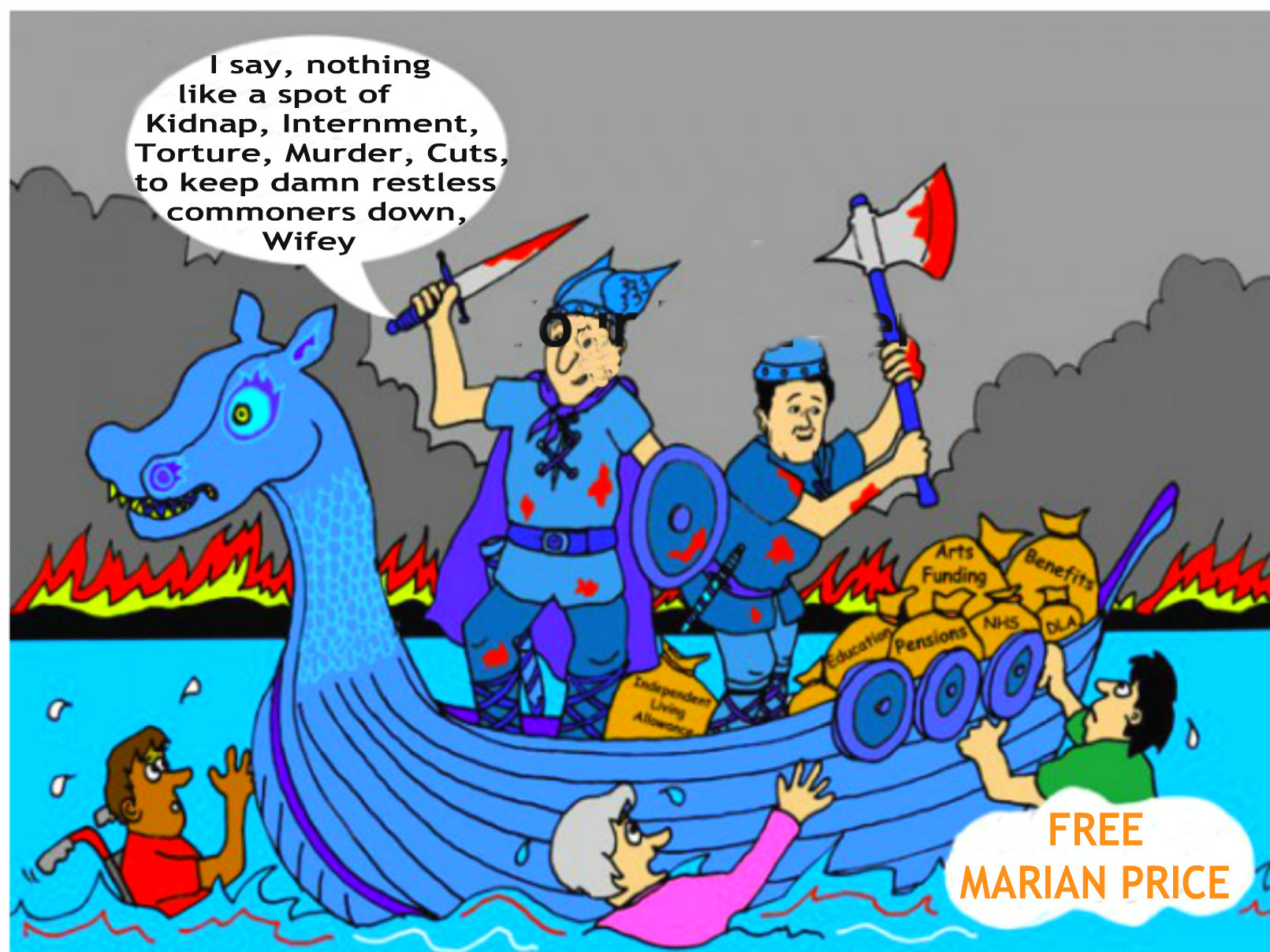
Cutting Commoners Down to Size
The British Vice Royal in British Occupied Ireland, Theresa Villiers, while on a visit to Dublin, at the start of October, asked, about the internment without trial of republican Marian Price interned in May 2011, by her predecessor Owen Paterson, claiming to revoke a non-existent licence, on which she had been supposedly released in 1980, stated. “A number of people have raised this with me, so I know it’s a sensitive issue, I know there is concern about it, but the reality is that this is not a decision for me, this is a decision for the Parole Commissioners and they are conducting their review at the moment. If I were to seek to intervene politically in what is a legal process I think that would be wholly inappropriate.”

This statement is at best disingenuous, a clearly irresponsible deception and non factual. In May 2011, Marian Price was arrested and interned to Maghaberry Prison on trumped up accusations, after holding a piece of paper on a windy day, at a traditional Easter commemoration, from which a masked man read. She was taken to Maghaberry high security prison an all-male prison and placed in solitary confinement, where she was accused of, ‘encouraging support for an illegal organisation’.

Marian has now been in prison for 17 months, during which time neither her lawyers or Marian, have been allowed to see any of Britain's ‘alleged’ evidence. Having been previously force fed 400 times by the British in an English prison, in considerable, ill health, distress, extreme pain and close to death, she was given a Royal Prerogative of Mercy, witnessed by Cardinal O'Fiach the spiritual leader, of Ireland's largest Christian denomination at the time.

Villier's predecessor Patterson claimed, that this Royal Pardon was either lost or shredded by his bureaucrats, something both he and Villiers are clearly responsible. This the first and only time that this has happened. Patrick Ramsey, a Social Democratic Labour member of the elected British Assembly, wrote to Paterson about this "lost" pardon and formally om his elected capacity asked;

-- Where would Mrs. Price-McGlinchey's pardon have been held?

-- How many staff are currently seeking the document and in what departments?

-- Are those looking for it doing so on a full-time basis, if not, why not?

-- Has the Northern Ireland Office received comment from the judiciary on the apparent loss of the document?

-- How many Royal Prerogative's have been lost (or destroyed) that the government has record of?

-- Who is ultimately responsible for the care and maintenance of the building where these documents are kept?

-- What communication [has Paterson] personally had with this person/Department?

-- Can [Paterson] confirm the Department is still seeking the document and will do so until it is found?

Again the unelected English Vice royal Paterson contemptuously dismissed the elected Irish assembly member, Ramsey's inquiry, the fruits of a Peace Process, after 30 years of war, stating that "unfortunately the Royal Prerogative of Mercy was not recovered but had no bearing on current circumstances. Patterson went even further and demanded, the local elected Assembly be downsized and it's 'peace process' structures be dismantled, as he regarded it simply as a talking shop, that interfered with unelected, Vice Royal English rule in Ireland.

Ms. Villiers herself, to be sure, to be sure, apparently, wrote an academic legal book, titled the Law of Estoppel, Variation and Waiver while apparently being an Academic of King's College London. She would hopefully then, be vaguely aware of her responsibilities and familiar with British law. It follows therefore, if the institutions to which she has been aligned, have any international credibility, she ought to be aware of the serious nature and consequence, of perverting the course of her own supposed British Justice system, something clearly not a reality in British Occupied Ireland, as this affair demonstrates to any objective observer not insignificant in a Peace Process without Due Process.

The facts of the case are as follows;

• Marian has been kept in solitary confinement in a ‘male’ high security prison
• She is effectively interned without a trial, sentence, or release date.
• She has not been given any timescale for any investigation.
• She has not been allowed to see the evidence that the state claims to have
• Her release has been ordered on two occasions by judges. However, on both occasions the secretary of state has overruled those decisions.
• The secretary of state claimed he ‘revoked Marian’s license’. This is despite Marian never being released on license. She was given a Royal Pardon.
• Marian’s Royal Pardon has ‘gone missing’ from the home office (the only time in history). The secretary of state has taken the view that unless a paper copy can be located – it must be assumed that she does not have one.
• Despite no ‘license’ existing for her release from prison in 1980, it is the non-existent license that is being used to keep her in prison.
• She can only be released by Theresa Villiers the current Secretary of State responsible despite her protestations

The charges against Marian Price were thrown out of their own British courts, for lack of evidence by a Judge, the last time she appeared and now the very same charges have been re-instated against Marian again in a British judicial system, that can provide any tangible evidence as to the reason for her internment. The farcical affair, demonstrates the British have learned nothing from their intransigence around Bloody Sunday and further the disingenuous nature of Cameron's belated, superficial apology. Neither have they learned from their collusion in the sectarian murder of thousands of Irish innocents or their shoot-to-kill policies, or any of their errors, in the last forty years of occupation and repression in British Occupied Ireland, never mind over 800 years of bloody oppression of the whole island of Ireland. Ms Villier's statement on the Marian Price debacle, smacks of the same arrogance, falshoods, injustice and sheer bloody mindedness, so much part, of their far-reaching colonial and recent bloody history.

Marian Price, is a symbol of her community, an Irish community, that the British ruling elite have spent years, trying and failing to silence and and subjugate. They have tried and continue to try, batter it into submission with internment, torture, state sanctioned murder and genocide. Milosevic's role in the tragic massacre an war crime of Srebrenica, was chicken feed, compared to the role the Villier's family have played in ethnic cleansing, war crimes and the holocaust in Ireland. Marian Price will not be silent until she is six foot under and for her lack of compliance she must silenced with political internment torture, without a proper trial, by the British occupiers and Ms Villiers is another insincere, superficial expensive mouthpiece for their criminal activity which includes kidnap. Despite her long family ancestry of being directly involved, as previous Vice royals in the Irish Holocaust, that cost 6,257,456 Irish person's lives, Villiers comes to Ireland, like so many of her predecessors, ignorant, not surprising with the sort of irresponsible, selective, subjectivity her statement demonstrates.

Marian Price has suffered enough and while we may not have agree with her tactics, we must defend her human rights. Britain has never voluntarily been interested in human rights or fairness and their intransigence is nothing new. For those of us who have been willing, despite considerable historical evidence to the contrary, to give the Peace Process in Ireland a fair chance and accept the challenge of it being an alternative avenue to physically resisting British political state violence, the Marian Price affair, is a poor omen. There have been many superficial calls for peace in Ireland but for those of us confronted with the daily reality of political violence, we know, as sure as night follows day, a Peace Process without Due Process or justice is going nowhere.

Ms Villiers despite her education at the King's Inn, appears to be selectively ignorant of this obvious fact or perhaps its just plain old familiar British hypocrisy and more of their worldwide piracy. Ms Villiers after graduating, worked as a barrister and as a lecturer at King's College London, 1994–99, perhaps like a lot of her colleagues, she partakes of an extra sup with them, before making public utterances, that fans the flames of injustice, that incites otherwise peaceful people to desperate and unwise reactionary violence.

Marian Price must be freed, that is the challenge to you and to all of us who claim to love peace. For those of us of the Irish diaspora, we are all Marian Price, consciously or subconsciously and we have as much freedom or the lack of it, as we allow irresponsible leaders like Villiers, and her long line of British blue bloods, steal from us in Ireland and worldwide. We need international help to achieve this peacefully, despite Tory provocation in the interests of their political sponsors, the British industrial war complex.
Related Link: http://irishblog-brianclarkenuj.blogspot.com/

FriendFeed

IrishBlog

Twitter follow

THE WIND THAT SHAKES THE BARLEY IN IRELAND - SHARE

Share/Bookmark

Facebook Badge

Facebook

BOBBY SAND'S COMRADES TORTURED AGAIN OCCUPIED IRELAND

BOBBY SANDS COMRADES TORTURED AGAIN OCCUPIED IRELAND -http://... on Twitpic

Fwicki

Fwicki - RSS Management, Multimedia Data Portals, Syndication Consulting Services

YouTube

Friendconnect

javascript

Subscribe

Enter your email address:

Delivered by FeedBurner

networkedblogs

Search This Blog

AllVoices

Iraq Death Estimator

Iraq Deaths Estimator

ShareThis

NEWS you WON"T find on the BBC

LinkWithin

Related Posts with Thumbnails

BlogCatalog

Music Blogs - BlogCatalog Blog Directory

Irish Blogs

theBestLinks

Watch favourite links

LinkWithin

Related Posts with Thumbnails

Slashdot

Subscribe to updates

Share on Friendfeed

FriendFeed badge

Irishblogdirectory

Irish Blog Directory

My Headlines

Subscribe Now: Feed Icon

Newstrust

irishblogs

Irish Blogs

Subscribe Now: Feed Icon

Subscribe via email

Enter your email address:

Delivered by FeedBurner

My Headlines

My Headlines

Twitter Updates

    follow me on Twitter

    My Headlines

    Ireland Headline Animator

    Slashdot

    PLEASE RE-TWEET THIS BLOG !

    My Headlines

    Newstrust

    Follow Blog

    IrelandYouTube Headline Animator

    Subscribe Now: Feed Icon

    TweetIt

    My Blog List

    Followers

    Blog Archive