Irish Time

Tuesday, August 7, 2012

41 Year Anniversary Ongoing British Torture Internment Occupied Ireland


London 2012 may be, where the Olympic Games are happening but it is also probably the capital, of world wide human rights abuse. Right now Marian Price is dying in internment torture without trial, as a political prisoner of conscience. She has been force fed for more than 6 months of a hunger strike and tortured in solitary confinement for almost a year, an Olympian feat by an standards of resistance, in the context of being interned without trial 41 years, after the introduction of internment into her life experience, with two judges ordering her release, along with the queen of England. They have however been overruled by an even darker, secret force, with a record of sadistic low intelligence in Ireland but a law unto themselves only.


Forty one years ago in the early hours of the 9th August 1971 British soldiers introduced internment without trial, by kicking in the doors of hundreds of Irish homes at 4.A.M in the morning. Internment torture has been used by the British Government in British Occupied Ireland, in every decade since the creation of their sectarian based scum state, to suppress any form of genuine political opposition. Internment since the creation of British Occupied Ireland has happened in the 1920s, 1930s, 1940s, 1950s, 1960s 1970s, 1980s, 1990s, 2000s  and today as another Irish woman called Marian Price is dying, while many other republican suspects are imprisoned without trial. Despite the spin of a peace process the reality is a police state without due process ran on injustice, sponsored sectarianism and British bigotry.


The secret services relied on faulty intelligence with the British Army kidnapping 342 men. The intelligence was totally inaccurate and most of those arrested had no connections with paramilitary organizations. Others while progressive minded, in belief were not active for decades.Prominent Civil Right's members and in some instances in Armagh the British Army ripped the area apart trying to find and kidnap people who were dead for more than 4 years.Intelligence rlied then and now on paid informers who would say anything to collect their beer and drug money, resulting then and now on totally inaccurate intelligence. British alienation from the community created a huge intelligence gap in their files then as it does now. Intelligence was so far off the mark that within 2 days the British were forced to release 116 of those kidnapped by the British. So it is with internees like Marian Price and Martin Corey today.


Internment and British torture were so much part of the Irish Republican experience, that they preempted it accordingly. No Loyalists were arrested in the initial operation, despite the UVF being active with British sponsored sectarian murders since 1966. The first Loyalist internees were not kidnapped until 1973. The reaction of the community was rage, reinforced with news of barbaric British torture of the internees. This rage increased support for the IRA and started a campaign of civil disobedience that was supported by everyone in the nationalist community.British brutality in the internment centres and internment was seen as communal punishment to humiliate. The result was a backlash of violence across British Occupied Ireland.


In an  IRA press conference on the 13th August, Joe Cahill, the Officer Commanding Belfast IRA stated that internment had had no effect on IRA structures and would continue.The ranks of the IRA were swollen with volunteers after the introduction. In the remainder of August 1971 after internment was introduced, 35 people were killed, more than the total for the previous 6 months.With the impending death of Marian Price currently dying interned in British Occupied Ireland the IRA has been reorganized and volunteers are said to be flooding into its ranks.


DYING PRICE OF 41 YEARS INTERNMENT TORTURE


In British Occupied Ireland concentration camps such as Long Kesh happen every decade or so and on this the 41st anniversary of internment without trial, IT is commemorated with the dying Marian Price, who is but one of many Irish political prisoners still interned without trial in British Occupied Ireland. Marian who was force fed by the British for over six months, was held in solitary confinement for close to a year, is now in intensive care with acute pneumonia. Marian Price's condition is described as “serious” and her family has expressed deep concern about her deteriorating physical and mental health. On Tuesday last ,she was diagnosed with pneumonia and moved to the main hospital.

Olympics London2012 No Gold Host Not so Great Britain & North Korea     http://brev.is/Cxa3
Views 25,701

Forty one years ago hundreds of people  were detained without trial in Long Kesh Concentration Camp during the period, which began on 9 Aug 1971. Marian Price was just a teenager then who like a lot of young people, was swept away in the ensuing tide of injustice created by the British army's Occupation of Ireland. 

Today  41 years later she is dying, while still interned without trial by an un-elected British vice royal in Ireland. The Guineapigs is the title of a book which first appeared in 1974 in London written by an internee John McGuffin. It sold out on its first print run and was abruptly taken off the market following pressure from the British Government. The book was about fourteen Irish political prisoners on whom the British Army experimented with sensory deprivation torture in 1971.

 These 'techniques' although now outlawed, following Britain's conviction at the International Court of Human Rights at Strasbourg, have been exported and used by Britain's allies throughout the world.The techniques were again used on Marian Price while held in solitary confinement last year. Marian was previously force fed and she is now dying from pneumonia and in considerable pain as a direct result of British torture.

In Ireland in 1971 there was deliberate and careful use of modern torture techniques, not merely to get information but to perfect the system of Sensory Deprivation for use against civilians. The author, an ex-internee himself spent two years researching the book following his release from Crumlin Road jail where he had been held without charge or trial. In the newer edition he was able to name the torturers and those responsible. No member of the British Army or the Royal Ulster Constabulary has ever been convicted of torture or brutality to prisoners, although the Government was been forced to pay out over $5 million in compensation to torture victims.


This is an account of the next eight days. It is taken from the victims' own words, in their statements to the Association for Legal Justice and from private interviews. First Joe Clarke, then aged 19, single, motor mechanic: "After being hooded I was led to the helicopter and I was thrown bodily into the helicopter. During this exercise my hands and wrists were hurt due to the others handcuffed to me not being pushed equally. (Before being led off to the helicopter, I understand that one of the hooded men, now known to be F. McGuigan, collapsed when the hood was first applied.) On being put into the copter, the handcuffs were removed and were applied to the back of the hood to tighten it around the head. The helicopter took off and a journey which I would estimate to have taken about an hour began. The helicopter than landed at a destination unknown to me and we were taken from the copter and led into a building and eventually into a room where I was made to stand in a search position against a wall. My position was the same as for other men – fully stretched, hands as far apart as humanly possible and feet as far from the wall as possible. Back rigid and head held up.

Not allowed to relax any of the joints at all. If any relaxation of limbs – arms, elbow joints, legs, knee joints – someone came along and grabbed the limb in a rough manner and put it back into position again. After being against the wall for a few hours. I was taken away and brought, I was told, to a doctor. Sometime during this period I was taken out of this room, put into a helicopter and flown away. I was always handcuffed and hooded. When the 'copter landed I was put into a lorry, driven a short distance, transferred to a jeep, five-minute journey, put into another 'copter, taken for half-hour journey. End of journey put into a police van, driven short distance, five-ten minutes, beaten about the face and body, transferred to other vehicle. Holding my face, asked why, said that I did not want to be beaten again.

Assured that I wouldn't be. Brought into a building, hood removed, shown detention form. Hood replaced, return journey as before The build-up to this collapse was frequent numbing of the hands which when it happened I closed my fist only to find that my hands were beaten against the wall until I opened my fingers again and put my hands back into position. On the other occasion I tried to rest by leaning my head against the wall but the response to this was my head was 'banged' on the wall and shaken about until I resumed my position. All the time there was the constant whirring noise like a helicopter blades going around. From the sound of this noise I would say that it was played into the room where I was because on the occasions that I was taken from this room even outside the door of the room the noise was noticeably vague almost to be inaudible.

As I have said, I collapsed completely after that long period of time. I was brought round and carried out into the main room again and made resume my position as before against the wall. There then followed a series of collapses – I could not say how many times I collapsed. Initially my hands and legs were beaten whenever this happened and the insides of my feet were kicked until my ankles were swollen to almost twice their normal size. After a number of these collapsings I was then made sit on the floor, with my knees up to my chest, my head between my knees and my arms folded around my knees. In this position I was swayed backwards and forwards in order I presume to bring my circulation back. Whenever this was done I was put against the wall again in the original position. The noise was insistent, driving mental resistance to its utmost. I thought that I was going mad. This noise was the only noise one heard save the groans of the other people lined up against the wall.

All the time that I was against this wall I got bread and water once and water alone on two other occasions. This was fed to me by the hood being lifted to my nose and bread and water was fed into my mouth in this way. I should emphasize that I was fed, I did not feed myself. The cup of water was put to my mouth and the bread was put into my mouth. I cannot possibly estimate for what duration I was against this wall and underwent the collapsing experiences and physical torture against this wall, but I would estimate that it must have been at least two full days and nights. During all of the time no sleep was permitted. At the end of the period I must say that I was extremely fatigued both physically and mentally. I was certainly verging on complete mental exhaustion, suffering delusions which were of nightmarish nature. I was taken out of this room – into another room where my hood was removed and I found myself confronted by two plain-clothes RUC SB men, one of whom was standing beside a table and the other was seated behind it. I was told by these men that I had asked to see them. I do not recollect ever having done so. I told them I did not ask for anyone. They then began to interrogate me. These men did not introduce themselves to me, so I do not know who they were. The hood was removed during this entire interview. These men interrogated me for a couple of hours. I should say that at the start of this interview I imagined that I was talking to my brother. At the end of this interview the hood was put back on again and I was put back into the other room and put against the wall. I asked where I was but I was told that I could not be told. As I was against the wall this time I was given a beating: kicked about the legs, a knee was stuck in the base of my spine and the hood was jerked back tight on my face, hurting my neck.

 I collapsed at the end of this beating. I was also punched in the ribs and in the stomach, as well as being nipped. I was brought round after collapsing and put up against the wall again. The nipping and punching on the arms and ribs commenced. At that I shouted Fuck off', and punched one of my assailants. I was then grabbed by a number of people and I was punched, kicked and kneed all over the body, stomach, ribs and back of my head. The hood was pulled tightly around my neck, nearly suffocating me. I was then put back against the wall. After a short time against it I collapsed. I do not know for how long I was out. The next thing that I clearly remember was sitting in this small room with the same two men as before, who again told me that I sent for them. The hood was taken off for this interview as well. This interview lasted only a very short time, a matter of minutes. I was re-hooded and taken out again into another room where I was beaten continuously for a long number of hours.

During the beating I was asked questions concerning the IRA, naming various people, and they also asked me about arms dumps. During all of this time I was standing. Due to the beating – mostly about the body and head, not face – I fell unconscious. When I awakened I was lying on a floor and as I was waking I was being punched. During this period of unconsciousness I had a dream where a friend of mine – my fiancee's brother – bought a scrap-yard. Whenever I awoke and found myself being beaten I began to struggle – I kicked one person and punched another. I was then overcome – my hands were put behind my back and I was handcuffed in this position.

There was an attempt to handcuff my ankles. I was then carried down a flight of stairs into a further interrogation – by a different person than previously. The hood was taken off. He told me that I had sent for him. I said that I did not but that I had asked for a priest. He told me that I would get no priest there. After a few questions I was re-hooded and led outside and into another room where I was made, hands still handcuffed behind my back, stand facing a wall with the crown of my head leaning against the wall. As I stood there my arms were pulled further back causing my wrists to be cut and torn. I was left alone in this room un-hooded for a few hours. This same SB Branch man came back in but was very gentle in the course of questioning. He would have questioned me for two to three hours. He then left me again alone in the room – this time for about six hours.

He returned when it was morning and told me that I was going back in for a few hours. I asked him where and he said, 'to the jail'. He brought me into a washroom and helped me to shave and have a general clean-up. I was then brought to a doctor. I complained to him of dizziness and pain in my right knee. He bandaged it and gave me an examination. Then I was photographed in the nude both front and rear. I was given my clothes back when I got back to the room. I changed and, after about an hour, I was brought now re-hooded to a Land-Rover and then after a short journey of five to ten minutes was put into a 'copter. After about an hour's flying journey we landed. Taken out. I know now that I was landed at the back of the prison (Girdwood). Marched through a hole in a wall. Across a football pitch and then put into a jeep. Driven to a gate – transferred into another police jeep and driven to the prison reception. I asked in the prison reception, where I was weighed etc., what day it was and he told me Tuesday. I said that it couldn't be since I was in Girdwood on Tuesday but he told me that that was a week ago.

After going through the formalities of reception I was put into a cell in the basement where I was kept until the following morning when I was transferred to C wing amongst the other detainees. Whilst in the basement I was given a meal – the first substantial food I received in over a week."

It is worth noting that of the twelve men only Clarke physically resisted. After days of ill-treatment and goaded beyond control, he reacted with an attempt, albeit futile, to strike out at his captors and tormentors. Dr. Pearse O'Malley of the Mater Hospital, Belfast, who examined two of the 'guineapigs' while they were recovering in Crumlin jail from their ordeal, has explained[2] how during the intensive sensory deprivation, as the disorientation is prolonged, aggression is likely to manifest itself. In the case of Joe Clarke this took the form of trying to retaliate, but in the case of at least two other men the agression became inverted and they even attempted suicide, by throwing themselves head first at the water-pipes.

Monday, August 6, 2012

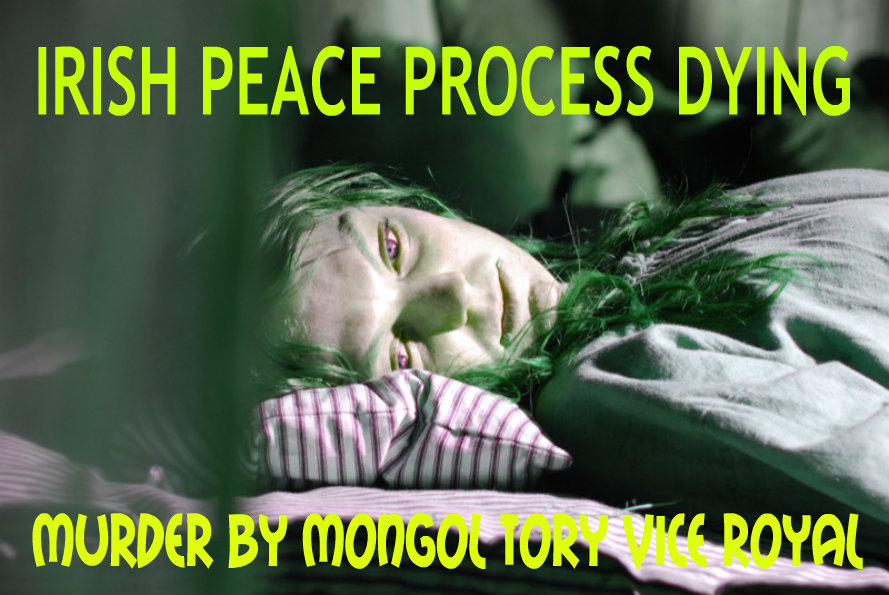
IRISH PEACE PROCESS DYING


Irish Peace Process Dying

category international | crime and justice | news report author Tuesday August 07, 2012 04:12author by BrianClarkeNUJ - AllVoices Report this post to the editors
Murder By a Mongol Tory Vice Royal
In British Occupied Ireland concentration camps such as Long Kesh happen ำvery decade or so and today the highlighted internment of the dying Marian Price is but one of many Irish political prisoners interned without trial. Marian who was force fed by the British for over six months was held in solitary confinement for close to a year is now in intensive care with acute pneumonia. Marian Price's condition is described as “serious” and her family has expressed deep concern about her deteriorating physical and mental health. Marian was moved from Hydebank prison to a unit of Belfast City Hospital, where she was receiving treatment for severe depression but her health continued to fail. On Tuesday last she was diagnosed with pneumonia and moved to the main hospital.
Dying in Internment
Dying in Internment
The English term "concentration camp" was first used to describe camps operated by the British in South Africa during the Boer War. When Kitchener became commander-in-chief in South Africa in 29 November 1900, the British Army introduced a new tactic to break the guerrilla campaign in South Africa. Kitchener attempted to "flush out guerrillas in systematic drives, like a sporting shoots, with a weekly 'bag' of killed or captured and wounded, sweeping the country bare of everything, that could sustain the guerrillas, including women and children. Of the 28,000 men captured as prisoners of war, 25,630 disappeared while 26,000 women and children were murdered by the British, the inventors of the original concentration camps. Of the extra 107,000 black Africans who were interned, the precise number of their deaths in concentration camps is unknown, as the British did not bother to count them.

In British Occupied Ireland concentration camps such as Long Kesh, happen every decade or so and today the highlighted internment of the dying Marian Price is but one of many Irish political prisoners interned without trial. Marian who was force fed by the British for over six months was held in solitary confinement for close to a year is now in intensive care with acute pneumonia. Marian Price's condition is described as “serious” and her family has expressed deep concern about her deteriorating physical and mental health. Marian was moved from Hydebank prison to a unit of Belfast City Hospital, where she was receiving treatment for severe depression but her health continued to fail. On Tuesday last she was diagnosed with pneumonia and moved to the main hospital.

Human rights activists and peace supporters are currently trying to organise an international human rights campaign, to pressurise the British establishment to immediately free Ms Price before it is too late.The prison authorities boarded up the windows of her intensive care room in hospital, until the staff protested against it. “Unless immediate action is taken to save Marian’s life, she, like Giuseppe Conlon in 1980, will die a prisoner, another innocent victim of the British ,” says Geraldine McNamara of Republican Sinn Féin. “Marian’s continued detention is yet another breach of human and civil rights by the British Establishment who continues to occupy the six north-eastern counties of Ireland.”

Marian's husband, Jerry McGlinchey, said: “We’re extremely worried. Marian has been in constant pain for months.Nobody has to agree with my wife’s politics to see this is wrong and violates her human rights.” Ms Price was interned without trial by British Direct Ruler Owen Paterson. Mr McGlinchey said: “I’ve nothing to say to Owen Paterson, but I appeal to the Justice Minister to show compassion and release my wife.” Sinn Féin’s Jennifer McCann said her party had confirmed the deterioration in Marian Price’s condition. “It is unacceptable that despite being moved from prison that she remains in custody with her historic licence still revoked,” she said.“It has long since passed the time when the British government moved to show some genuine compassion in this case and reinstate Marion Price’s licence and allow her to return to the care of her family without any further delay.“I will be making contact with the British government to continue to press them to release Marion Price before further damage is done to her health.

The destruction of the Peace Process in Ireland is a calculated one, where currently on the British side of the peace process equation, the Historical Enquiries Team (HET), in conjunction with the PSNI , are in the process of framing criminal charges against people who were active as combatants, when the war that was meant to be now ended in British Occupied Ireland, was still raging. Subpoenas served against the Belfast Project archive at Boston College, is an example of this activity but it is not by any means the only one. The political blessing was clearly given by the Tories, who regard PSF and the process generally as 'lefty crap'. They essentially have decided to resume the war and to put people who fought against them previously in the war in prison.

Dissident Unionists with whom Owen Paterson the present Secretary of State, has been working tirelessly for years to co-opt into his Tory party, now being led by Nigel Dodds and Maurice Morrow are only puppets, being used by the ‘securocrats’ of MI5 and MI6 who work quietly, ceaselessly, behind the scenes directing the current Anti Good Friday Campaign, which in essence, is a de facto abrogation of the peace deal by the British. Along with the sinister elements working quietly behind the scenes Foster and Morrow, have never supported the peace agreement and do not want it to work as they continue to prevent a sustainable just peace in Ireland to continue instead, with their Protestant State for a Protestant People, i.e permanently British for their mentors.

.
To confirm Tory intent to destroy the process, it has become clear within the past year that Paterson, MI5 and the PSNI are rolling out a covert form of Internment without trial in British Occupied Ireland, aside from the obvious ones in the instance of Marian Price and Martin Corey, they are remanding without credible evidence, many political activists, perceived as a threat to the Stormont state. Lengthy waiting times, courts which unquestioningly accept police statements, provided by war motivated British military intelligence and the political policing of the paramilitary PSNI system that detains, charges and remands republicans, with little or no evidence at all. Republican activists are being removed from the street for strictly political reasons for up to three years at a time, effectively bypassing any pretence of the civilised concept of ‘innocent until proven guilty’.or the centuries old protection of the Magna Carta or Habeus Corpus.

What we are witnessing, is the rebirth of the same old Orange scum state of fascist round up, or a so-called peace process without due process. This in fact is a process in which all freedom loving citizens who prove inconvenient to a scum state, face life in prison without due process. Sadistic animal killers and hunters of the the Tory horsey set in Irish and British society are now leading these draconian practices. Millionaire Tory fox-hunting aristocrat, Owen Patterson has overseen the kidnap of Marian Price and Martin Cory, both elderly, gravely ill, the innocent victims of political conscience, to orange sectarianism and British bigoted hatred of Irish republicans and equality. While they are currently not mainstream republican, no one has a monopoly on the truth or Irish republicanism and they are both long time members of the Irish Republican Movement, who have given all in the service of the Irish Republic.
Related Link: http://irishblog-irelandblog.blogspot.com/

VIdeo Demonstrates Why Tory Minister Should Resign


Owen Patterson's Letter to the Guardian Contradicts Himself

You refer in your editorial (Northern Ireland: keep focused, 28 July) to the case of Marian McGlinchey (nee Price). I should be grateful for the opportunity to set out the facts.
Marian McGlinchey received two life sentences in 1973 for her part in the Old Bailey bombing. She was subsequently released on licence in 1980. At the same time she was granted the royal prerogative of mercy (RPM) in respect of a separate conviction which carried a 20-year fixed term sentence. The RPM did not cover her life sentences.
All life sentence prisoners remain on licence for life. They can be recalled at any time if they breach the conditions of their licence or pose a risk of serious harm to the public. A similar system was endorsed by the previous government in the legislation to give effect to the part of the Belfast Agreement that dealt with the early release of prisoners.
Before revoking a prisoner's licence under the Life Sentences (Northern Ireland) Order 2001, however, the secretary of state must first seek a recommendation from the wholly independent parole commissioners. This is what I did in the case of Marian McGlinchey; their recommendation was that she was in breach of her life licence. Consistent with my overriding responsibility in Northern Ireland for public safety, and in accordance with the law, she was returned to prison.
The independent parole commissioners are now reviewing the case in full. If they are satisfied that it is no longer necessary for the protection of the public that the prisoner should be confined, then they may direct the prisoner's release. The prisoner has full legal representation and can challenge the case made against her; Marian McGlinchey has yet to do this. The decision of the parole commissioners is final and cannot be overruled by the secretary of state.
It would be outrageous for any secretary of state to do anything other than adhere strictly to the law. Yet the clear inference in your editorial is that I should discard due process and interfere politically in this case. That would fatally undermine the rule of law in Northern Ireland. That is not something I am prepared to do.
Owen Paterson MP
Secretary of state for Northern Ireland

There is an obvious and blatant contradiction between what  Monsignor Raymond Murray says and the statement of Patterson.who besides being responsible for  loosing or shredding the royal prerogative, is obviously contradicting himself in no uncertain terms, without any official investigation. This Tory bufoon should resign immediately and stand trial for both the attempted murder and kidnap of Marian Price in British Occupied Ireland


Another Irishwoman Being Murdered by London 2012


The SAS gave no warning prior to shooting. Carmen Proetta, an independent witness, told Thames Television "They [the British] didn't do anything. They just went and shot these people. That's all. They didn't say anything, they didn't scream, they didn't shout, they didn't do anything. These people were turning their heads back to see what was happening and when they saw these men had guns in their hands they put their hands up. It looked like the man was protecting the girl because he stood in front of her, but there was no chance. I mean they went to the floor immediately, they dropped."


It was the unarmed Mairead Farrell and her comrades murdered by the British, now it it is Marian Price being murdered by the British, while interned without trial, after the courts and queen of England ordered her release. As Margaret Thatcher who gave the SAS their orders said, "Murder is Murder." Marian Price has been held in solitary confinement for almost a year, force fed 400 times and interned without trial, she is a free spirit dying from British injustice in Occupied Ireland. She is close to 60 years of age and has never known freedom in her own land.


PRICE IN INTENSIVE CARE


marianpricebig.jpg 
Interned political dissident Marian Price has contracted pneumonia, it has emerged.
Ms Price’s condition is described as “serious” and her family has expressed deep concern about her deteriorating physical and mental health.
In June Price was moved from Hydebank prison to a unit of Belfast City Hospital, where she was receiving treatment for severe depression. But her health has continued to fail. On Tuesday she was diagnosed with pneumonia and moved to the main hospital.
Campaigners have urged activists and supporters to help organise an international human rights campaign to pressurise the British establishment into immediately freeing Ms Price.
The prison authorities boarded up the windows of her intensive care room in hospital until the staff protested against it, said Geraldine McNamara, National PRO of Republican Sinn Féin.
“Unless immediate action is taken to save Marian’s life, she, like Giuseppe Conlon in 1980, will die a prisoner, another innocent victim of British ,” she said.
“Marian’s continued detention is yet another breach of human and civil rights by the British Establishment who continues to occupy the six north-eastern counties of Ireland.”
Her husband, Jerry McGlinchey, said: “We’re extremely worried. Marian has been in constant pain for months.
“Nobody has to agree with my wife’s politics to see this is wrong and violates her human rights.”
Ms Price was charged with encouraging support for the Real IRA last year, and subsequently interned without trial by British Direct Ruler Owen Paterson.
Mr McGlinchey said: “I’ve nothing to say to Owen Paterson, but I appeal to (Justice Minister) David Ford to show compassion and release my wife.”
Sinn Féin’s Jennifer McCann said her party had confirmed the deterioration in Marian Price’s condition.
“It is unacceptable that despite being moved from prison that she remains in custody with her historic licence still revoked,” she said.
“It has long since passed the time when the British government moved to show some genuine compassion in this case and reinstate Marion Price’s licence and allow her to return to the care of her family without any further delay.
“I will be making contact with the British government to continue to press them to release Marion Price before further damage is done to her health. 
_______________
As to why Marian has contracted pneumonia an important clue may be found in the following extract from the diary of Bobby Sands and is taken from where he is reflecting on his situation as a prisoner. "A stretch of tarmac surrounded by barbed wire and steel is the only view from my cell window, I’m told it’s an exercise yard. I wouldn’t know. In my fourteen months in H-Block, I haven’t been allowedto walk in the fresh air. I am on ‘cellular confinement’ today. That is the three days out of every fourteen when my only possessions, three blankets and a mattress, are removed, leaving a blanket and a chamber pot. I’m left to pass the day like this, from 7.30 a.m. to 8.30 p.m. How I spend my day is determined by the weather. If it’s reasonably warm, it’s possible to sit on the floor, stare at the white walls, and passa few hours day dreaming. But otherwise I must spend my day continuously pacing the cell to prevent the cold chilling through to my bones. Even after my bedding is returned at 8.30 p.m.hours will pass before the circulation returns to my feet and legs."
    

Clonoe families launch shoot-to-kill report


clonoemartyrsbig.jpg
Relatives of four IRA Volunteers killed by undercover British soldiers 20 years ago have launched a report to highlight their campaign to establish how they died.
Peter Clancy, Kevin Barry O’Donnell and Sean O’Farrell, from the Coalisland area, and Patrick Vincent from Dungannon were shot dead in the grounds of St Patrick’s Church at Clonoe, County Tyrone, during the covert British military operation on February 16 1992.
They were ambushed minutes after taking part in a gun attack on nearby CoalislandRUC station during which noone was injured. All four were aged in their late teens or early twenties.
A barrage of 514 rounds were fired at the IRA unit by 12 undercover soldiers, believed to include SAS members. Eight cars, each containing two soldiers, provided back-up to the undercover troops.
Despite the passing of two decades and more than 20 preliminary hearings, a full inquest into the men’s deaths has yet to be held.
Relatives travelled to the US in March and presented the report, which has been compiled by victim-support group Relatives for Justice, to Irish and American politicians.
Six-County Justice minister David Ford and PSNI Chief Matt Baggott also received copies.
Relatives believe the soldiers ignored chances to arrest some of the IRA men prior to the planned ambush.
Hours before the shoot-out, O’Farrell was stopped at a British army checkpoint near the spot where he died.
He was allowed to continue on his journey. O’Donnell’s sister Roisin Ui Mhuiri said she and the other relatives deserve to know what happened.
“It’s about finding out the truth,” she said.
“For 20 years they have refused to tell us the truth of what happened that night.
“This is going to eat away at us until we find out the truth.
“If we stay silent, which is the easy thing to do, it means we accept what happened that night.
“It was a well-planned military operation and we believe that instead of arresting those men, which they could have done, a decision was made high up to shoot them.”
“The British government should hold up their hands so we can move forward as a community and we can heal not only as families but as a community. Instead there are families still holding all this pain and grief.”
Controversy continued after the killings when 200 mourners walked out of the funeral Mass of O’Donnell and O’Farrell at the Church of the Holy Family in Coalisland after parish priest Mgr Liam McEntegart denounced the IRA leadership.
In the aftermath of the ambush the then British ‘security’ minister, Dr Brian Mawhinney, said he had no reason to doubt that the soldiers followed proper procedures.
The report, ‘Ambush, Assassination and Impunity’, was launched at the Cornmill Heritage Centre in Coalisland on Thursday night.
“It has become apparent that state forces had exact knowledge of the IRA plan to attack the RUC station,” the report by Relatives for Justice says.
“The obvious question would, therefore, be why the state made no attempt to arrest the IRA men.
“The deployment of SAS soldiers, noted solely for their ambush and execution methods, rather than effectively securing and making arrests in accordance with international standards, adds to the concern that the aim of this operation had indeed been to kill the IRA men and not to arrest them. This was never an arrest operation.”
It demands that the full inquest should now be held and that the Public Prosecution Service should review the case.


Historic IRA realignment


lraflags.jpg
A regrouping of previously distinct breakaway IRA groups is being described as the most significant development within physical-force republicanism since the Provisional IRA split in 1997.
In a statement released yesterday [Thursday] evening, the new IRA grouping said that following extensive consultation, the three organisations “have come together within a united structure under a single leadership subservient to the constitution of the Irish Republican Army”.
A completely new command structure and army council has been established to oversee the running of the new organisation which will combine the resources of all three former groups. It is believed members of the three original groups have already been briefed on the merger.
The transition was helped by the fact that a majority of the new IRA’s leadership previously held senior roles within the Provisional IRA at various stages of that organisation’s existence.
The new organisation does not include the Continuity IRA. In addition, one or two elements which operated under the name Oglaigh na hEireann [the Irish synonym for IRA] may not have been brought into the new group, particularly in Belfast.
In a statement issued by the regrouped organisation’s army council, the IRA said it remained “committed to the full realisation of the ideals and principles enshrined in the proclamation of 1916”.
“In recent years the establishment of a free and independent Ireland has suffered set backs due to the failures among the leaders of Irish nationalism and fractures within republicanism,” it said.
“The root cause of conflict in our country is the subversion of the nation’s inalienable right to self determination and this has yet to be addressed.
“Instead the Irish people have been sold a phony peace rubber stamped by the token legislature in Stormont.”
It said the continuing British denial of Irish self-determination remained the source of the conflict.
“It is Britain, not the IRA that has chosen provocation and conflict,” it said.
“The IRA’s mandate for armed struggle derives from Britain’s denial of the fundamental right of the Irish people to national self-determination and sovereignty.
“So long as Britain persists in its denial of national and democratic rights in Ireland then the IRA will continue to assert those rights.
“The necessity of armed actions in pursuit of Irish freedom can be avoided through the removal of the British military presence from our country, the dismantling of their armed militia and declaration of an internationally observed timescale that details the dismantling of British political interference in our country.”
It is unclear what motivated the new development, but the breakaway organisations have reported a surge in support since Sinn Fein’s Martin McGuinness shook hands and greeted the English queen, Elizabeth Windsor, as part of the British royal jubilee celebrations last month.
The increased size and relative unity within the organisation will directly challenge long-standing efforts by the political establishment in the North to portray republican militants as small or “micro” groups.
For the moment, there seems no possibility of an engagement between the two, but in the future, the organisation’s new combined structure could allow a single, coherent channel of communication.
North Belfast Sinn Fein assembly member Gerry Kelly recently described the breakaway IRA groups as “small groupings” but insisted that his party had sought to engage with them.
“They have no right to carry out armed actions, the vast majority of which are directed against civilians in republican areas, in the name of Irish republicanism,” he said.
One of the group’s involved in the merger, Republican Action Against Drugs, has operated a controversial vigilante campaign against criminals within the nationalist community in Derry. However, last month it began to target the PSNI, triggering a wave of raids and searches in which dozens of homes were ransacked, most recently that of the Sinn Fein Mayor, Kevin Campbell.
Other units or groupings involved in the merger include one which carried out an attack which killed a member of the PSNI in County Tyrone last year, as well as others which have used the name Oglaigh na hEireann, or simply ‘the IRA’.
While the full extent of the regrouping has yet to be confirmed, it has been reported that the new IRA has membership ‘nationwide’.
Meanwhile, in an apparently separate development, the Continuity IRA (CIRA) says it has expelled several members and has a new leadership.
A statement issued in Dublin said those acting in a criminal manner and using the name of the CIRA would be subject to “military action”.
The group said it remains determined to continue its armed campaign in the north. The CIRA has claimed responsibility for several attacks in recent years, including one in 2009 in which a member of the PSNI was killed.
There has as yet been no direct response to the development by Sinn Fein or other IRA groups.


Smithwick lawyers ‘bewildered and alarmed’ by PSNI secrecy


smithwickbig.jpg
Five intelligence documents were deliberately withheld from the Smithwick Tribunal by the PSNI police, the force has said, deepening the mystery over a profoundly murky incident from 1989.
The ongoing tribunal at Dublin Castle was set up to investigate claims that the Provisional IRA received assistance from a member of the 26-County Garda police in 1989. It was announced following unionist demands for a ‘balance’ to nationalist calls for inquiries into collusion between the British Crown forces and loyalist death squads north of the border.
Two senior members of the police (then RUC) died when they were ambushed as they crossed the border en route to Dundalk Garda station, allegedly afer inside information was passed to the IRA.
The revelation that the PSNI had withheld the documents was described as a matter of “great concern” by lawyers at the tribunal on Wednesday. Lawyers for the two families involved said it now appeared the PSNI may be hiding even more documents from the inquiry, while lawyers for Owen Corrigan, a Garda member who had been accused of assisting the IRA, said the PSNI had very belatedly produced evidence which cleared his client.
John McBurney, solicitor for the Breen family, said there was now “a truly bewildering and alarming array of collusion pointers”.
The PSNI has provided only “summaries” of the five intelligence documents, the originals of which they said were being withheld for “reasons of national security”.
Four of the five “summaries” related to reports that a garda in Dundalk passed information to the IRA. The fifth said a Dundalk garda named as Jim Lane had repeatedly warned of inappropriate relationships between members of the IRA and Dundalk sergeants.
While the first two documents made reference to “a detective” member of the Garda in Dundalk who was said to be passing information to the IRA, the summary provided said the unnamed detective officer in question was not involved in [or revealed to] the Smithwick Tribunal.
Jim O’Callaghan SC, for Owen Corrigan, said this was “exculpatory” information about his client’s alleged involvement with the IRA, and the PSNI had decided, at least initially, not to share it.
Asked if he was prepared to apologise to Mr Corrigan, the PSNI representative replied: “A decision was taken to not release this intelligence.”
He added that he was “not in a position to tell you who made that decision, the circumstances or the context in which that or those decisions were taken. And I’d be speculating beyond that.”


The merger of physical force republicans


newiragraffiti.jpg
A different take on last week’s IRA announcement, by socialist republican Tommy McKearney.
Organisations with strong centralised and hierarchal structures, especially the conviction driven, are usually prone to splitting or the breaking away of factions. Often this occurs at periods of significant political development or societal transformation when direction-changing decisions are required. This happens in religion, in sport and with unending regularity in the world of militant Irish republicanism. Three of the largest parties in the present Irish parliament, for example, had their origins in bitter divisions within the country’s republican milieu. Such a history, therefore, makes the news of a merging of certain forces within the present day republican underground, an interesting and indeed surprising development.
A small number of journalists were briefed on Thursday 26th July that three strands of what is sometimes referred to as the ‘physical force’ element of Irish republicanism had amalgamated. The Real IRA (best known to British readers for carrying out the 1998 Omagh bombing), a vigilante group called Republican Action Against Drugs and a low profile group of armed republicans still calling themselves ‘the IRA’ have united under the, hardly original, title of the Irish Republican Army. In its communique to the press, the group repeated its commitment to militarism when it spoke of the ‘... necessity of armed struggle in the pursuit of Irish freedom ...’
In spite of its newsworthiness, this development should be kept in perspective. In the first instance, this new IRA group will be confronted with a challenge experienced by every revolutionary organisation; that of maintaining security and secrecy in the face of energetic surveillance by the state. There is little doubt that this merger will simplify MI5’s task of monitoring and foiling the new group’s activities.
Secondly, there are two other bodies, still calling themselves the IRA that remains outside this merger. Therefore the fractious and divided nature of armed Irish republicanism remains as poisonous and debilitating as ever. The particular school of Irish republicanism represented in this new group is often more certain of what it opposes rather than what it stands for. This makes it difficult for them to build the type of broad support base necessary to influence the political process.
Most pertinent of all, though, is the fact that the new formation is unlikely to change significantly the balance of forces within Northern Ireland. Trying to estimate membership strength for the various militant groups is difficult because the level and depth of support can fluctuate widely depending on the time and circumstances. One of the anomalies of the current situation is that while Sinn Féin voters are strongly opposed to further armed action, many are unwilling for historical reasons to cooperate with the authorities. Acceptance for all aspects of policing remains ambiguous within most republican circles.
Nevertheless, an overwhelming majority of people in Northern Ireland are opposed to any resumption of the violent battle of the final quarter century of the 20thcentury. Every election since the Good Friday Agreement of 1998 has returned, from within the wider republican constituency, an overwhelming majority in favour of ending armed conflict and an equally strong rejection of those indicating any intention of recommencing insurrection. While there is no mechanical correlation between electoral support and ability or capacity to carry out direct action, the presiding officer’s count provides its own message. When people are unwilling to vote in secret for an insurrectionist candidate, they are unlikely to endure the unavoidable hardships and risks of war against the state. In practical terms there is insufficient water in which armed radicals can swim in Northern Ireland of the present day.
This low-key assessment notwithstanding; there is a message to be taken from a coming together of previously separate entities. It is rare for divisions in republican Ireland to be repaired or for groups to coalesce in this fashion. The significance of what has happened may not lie, therefore, in the new group’s potential for increased military capacity (and that is questionable hypothesis by any assessment) but in the fact that there is a new strategy in play and the process is towards unity rather than remaining separate.
Bear in mind that all is not well in Northern Ireland. Global recession is embedding economic and social hardship in areas that have experienced little improvement in their level of material prosperity over the last two decades. Sectarian divisions remain at a toxic level, especially in working class districts. Local devolved government performs a basic function of any parliament in that it is a substitute for civil war, yet it hardly makes any other obvious difference in the population’s day to day lives. Ominously, this new IRA is concentrated in the very areas where deprivation is most acute.
There is, in a nutshell, a space for dissenting voices to question the status quo and Irish republicanism is, after all, more a response to material conditions than it is an aspiration to a form of government. Five years ago a sense of estrangement manifested itself in France with youths burning property in the suburbs. Last year something similar happened in Britain when rioting broke out across urban centres.
Protest in Ireland sometimes follows an indigenous pattern and therein lurks the one great unknown factor in this latest ‘new departure’. Is this a huddling of desperate men determined to hang together rather than hang separately or is it an indication, even subconsciously, of a societal change that is encouraging direction-changing decisions?


FriendFeed

IrishBlog

Twitter follow

THE WIND THAT SHAKES THE BARLEY IN IRELAND - SHARE

Share/Bookmark

Facebook Badge

Facebook

BOBBY SAND'S COMRADES TORTURED AGAIN OCCUPIED IRELAND

BOBBY SANDS COMRADES TORTURED AGAIN OCCUPIED IRELAND -http://... on Twitpic

Fwicki

Fwicki - RSS Management, Multimedia Data Portals, Syndication Consulting Services

YouTube

Friendconnect

javascript

Subscribe

Enter your email address:

Delivered by FeedBurner

networkedblogs

Search This Blog

AllVoices

Iraq Death Estimator

Iraq Deaths Estimator

ShareThis

NEWS you WON"T find on the BBC

LinkWithin

Related Posts with Thumbnails

BlogCatalog

Music Blogs - BlogCatalog Blog Directory

Irish Blogs

theBestLinks

Watch favourite links

LinkWithin

Related Posts with Thumbnails

Slashdot

Subscribe to updates

Share on Friendfeed

FriendFeed badge

Irishblogdirectory

Irish Blog Directory

My Headlines

Subscribe Now: Feed Icon

Newstrust

irishblogs

Irish Blogs

Subscribe Now: Feed Icon

Subscribe via email

Enter your email address:

Delivered by FeedBurner

My Headlines

My Headlines

Twitter Updates

    follow me on Twitter

    My Headlines

    Ireland Headline Animator

    Slashdot

    PLEASE RE-TWEET THIS BLOG !

    My Headlines

    Newstrust

    Follow Blog

    IrelandYouTube Headline Animator

    Subscribe Now: Feed Icon

    TweetIt

    My Blog List

    Followers

    Blog Archive